
MEDICAL DISCLAIMER
This article is published for informational and educational purposes only. The content contained herein does not constitute medical advice, diagnosis, or treatment recommendations. All medical procedures discussed—including lens implantation, cataract surgery, and presbyopia correction—carry potential risks, complications, and individual variability in outcomes. Readers must consult qualified ophthalmologists, licensed physicians, and healthcare professionals before pursuing any surgical treatment. Vendurama functions as an elite informational publication and does not endorse specific hospitals, surgeons, or medical protocols. Medical tourism decisions should be made in consultation with your primary healthcare provider, with full understanding of risks, benefits, alternatives, and follow-up care requirements available in your jurisdiction of residence. Surgical outcomes vary by patient, and no guarantee of results is implied or expressed. Insurance coverage for international medical procedures varies by policy and should be verified directly with your insurance provider before commitment. This publication is not a medical provider and assumes no liability for treatment outcomes or travel-related medical complications.
Introduction: The Silent Productivity Tax of Visual Decline
For the global mass affluent professional—executives, entrepreneurs, and industry leaders aged 45 to 60—vision is not merely a sensory function; it is a critical business asset. Yet, this demographic faces a universal, inevitable erosion of that asset: presbyopia and early-stage cataracts. The onset of presbyopia typically begins in the mid-40s, manifesting as the inability to focus on near objects without reading glasses. For a high-performing executive, this is not a minor inconvenience. It is a friction point that interrupts the flow of work. The constant removal and replacement of glasses during board meetings, the squinting at smartphone screens during international calls, and the eye strain after hours of analyzing financial reports on digital displays all contribute to a cumulative “productivity tax.”
By the time early cataracts develop, often in the 50s, the degradation accelerates. Contrast sensitivity decreases, glare from oncoming headlights at night becomes hazardous, and colors appear faded. Standard domestic solutions often fall short for the elite professional. Monovision LASIK can compromise depth perception. Standard monofocal cataract surgery eliminates the cataract but leaves the patient dependent on glasses for most tasks. Progressive lenses offer a compromise but often induce distortion in the peripheral vision, causing nausea or dizziness during movement. For the individual whose livelihood depends on sharp cognition and uninterrupted focus, these compromises are unacceptable.
This reality gives rise to the “20/20 Executive” concept: a strategic approach to vision restoration that seeks not just correction, but optimization. It is the pursuit of clear, crisp vision at near, intermediate, and distance ranges, achieved efficiently through advanced surgical intervention. The core argument of this strategy is that standard domestic healthcare systems, often constrained by insurance reimbursement models and generalized treatment protocols, are insufficient for the specific demands of the ultra-high-performer. The “Smart Luxury” investment lies in traveling to Seoul, South Korea, for advanced, customized multifocal lens implants.
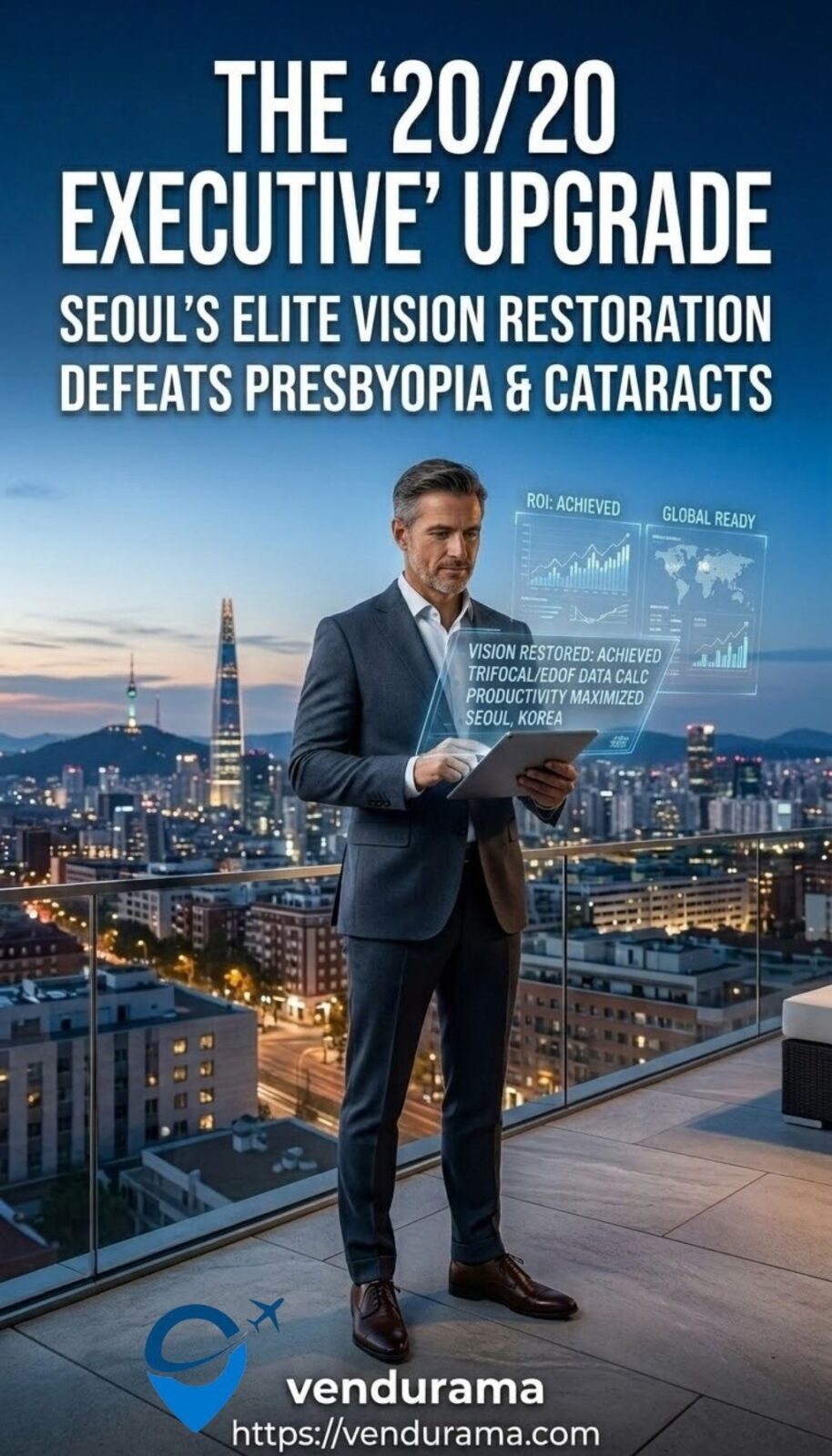
Seoul has emerged as the global epicenter for refractive lens exchange and premium cataract surgery. The city’s elite clinics combine world-leading technology, data-driven surgical outcomes, and a service model designed for efficiency and discretion. For the executive, this is not merely a medical procedure; it is a strategic upgrade to human capital. By restoring youthful vision, one reclaims the ability to work longer hours without fatigue, drive safely at night, and engage in leisure activities without the tether of corrective eyewear. The return on investment is measured not just in dollars saved compared to US premium procedures, but in the regained years of peak professional productivity and personal vitality.
The Seoul Advantage: Why Executives Choose Korea over Domestic Options
The decision to undergo elective surgery abroad requires a rigorous vetting of the destination’s capabilities. Seoul’s dominance in ophthalmic surgery is not accidental; it is the result of a convergent ecosystem of technology, volume, and cultural prioritization of precision. For the mass affluent patient, understanding the structural advantages of the Korean medical system is essential to validating the investment.
Technosphere & Data: The Precision Edge
South Korea leads the world in the integration of big data into surgical planning. In the context of lens implantation, the margin for error is measured in microns. A miscalculation in lens power of even 0.25 diopters can result in residual refractive error, necessitating glasses post-surgery. Korean clinics utilize proprietary algorithms that aggregate data from hundreds of thousands of prior surgeries. These algorithms account for corneal asymmetry, anterior chamber depth, and even ethnic variations in eye anatomy that Western formulas might overlook.
This data-driven approach minimizes the “surprise factor.” In the US, a patient might undergo biometry measurements and wait days for lens calculation. In Seoul’s top-tier clinics, the diagnostic suite is integrated directly with the surgical planning software. The surgeon can simulate the post-operative visual outcome in real-time during the consultation. For the executive patient, this transparency is crucial. It transforms the procedure from a leap of faith into a calculated engineering project with predictable deliverables.
Efficiency & Scale: The Volume-Quality Correlation
In surgery, volume drives proficiency. Seoul’s elite ophthalmic hospitals perform thousands of premium lens implantations annually, far exceeding the volume of most private practices in North America or Europe. This scale creates a specialized division of labor. While the lead surgeon focuses on the critical surgical steps, a dedicated team handles diagnostics, laser alignment, and post-operative care.
This efficiency translates to time savings for the international patient. A process that might take weeks of scattered appointments in a domestic system is compressed into a streamlined 3-5 day itinerary in Seoul. For the C-suite executive, time is the scarcest resource. The ability to arrive, undergo comprehensive screening, have the procedure, and receive clearance for travel within a single work week is a logistical advantage that offsets the cost of travel. Furthermore, high volume ensures that complications, while rare, are managed by teams with extensive experience in remediation, providing an additional layer of security for the patient.
Customized Precision: Advanced Lens Technologies
The core of the “20/20 Executive” upgrade is the lens itself. Standard monofocal lenses, often covered by insurance in the US, provide clear vision at only one distance (usually far), necessitating reading glasses for everything else. Seoul’s clinics specialize in premium intraocular lenses (IOLs) that restore the eye’s natural range of focus.
Trifocal Intraocular Lenses
Trifocal lenses are designed with three distinct focal points: distance, intermediate, and near. This technology mimics the natural crystalline lens of a youthful eye. For the executive, the intermediate zone is critical. This is the range used for computer screens, dashboard instruments, and tablet devices. Unlike bifocals or progressive glasses, which have “blind spots” or distortion zones, trifocal IOLs provide a continuous field of vision. Patients report the ability to switch focus from a spreadsheet on a monitor to a document on their desk without reaching for glasses. This seamless transition reduces cognitive load and eye strain, directly impacting work endurance.
Extended Depth of Focus (EDOF) Lenses
EDOF lenses represent a newer generation of technology that elongates the focal point rather than creating distinct zones. This creates a continuous range of vision from distance to intermediate, with functional near vision. The primary advantage of EDOF is the reduction of photic phenomena (halos and glare) at night. For executives who drive frequently or travel internationally across time zones, EDOF lenses offer a high-quality visual experience with minimal dysphotopsia. They are particularly suitable for patients with large pupils or those who prioritize night driving performance.
Accommodating Lenses
Unlike multifocal lenses that split light, accommodating lenses are designed to move or change shape within the eye in response to ciliary muscle contraction. This mechanism attempts to restore the eye’s natural accommodation (focusing ability). While the range of near vision may vary more than with trifocal lenses, the quality of vision is often described as more “natural” with fewer optical side effects. For the active professional who engages in sports or dynamic visual tasks, accommodating lenses offer a compelling balance of range and quality.
Selecting the correct lens is not a one-size-fits-all decision. It requires a nuanced understanding of the patient’s lifestyle, occupational visual demands, and ocular anatomy. Seoul’s specialists are trained to match the lens technology to the patient’s specific “visual portfolio,” ensuring the outcome aligns with their professional and personal goals.
The Patient Journey: From Diagnosis to Discretion
For the international patient, the medical journey is as important as the clinical outcome. The “Smart Luxury” experience is defined by white-glove service, privacy, and seamless coordination. Seoul’s elite clinics have refined this journey to cater specifically to high-net-worth individuals who demand discretion and efficiency.
Comprehensive Pre-Screening: The Foundation of Success
The surgical outcome is determined before the first incision is made. Upon arrival in Seoul, the patient undergoes a comprehensive diagnostic workup that exceeds standard domestic protocols. This includes corneal topography, optical biometry, wavefront analysis, and dry eye evaluation. The clinics utilize femtosecond laser technology for certain steps of the cataract removal, which increases the precision of the capsulotomy (the opening in the lens capsule) and reduces the ultrasound energy required to break up the cataract. Less energy means less inflammation and faster recovery.
This screening phase is critical for ruling out contraindications. Conditions like macular degeneration or glaucoma must be identified and managed before lens implantation. The thoroughness of this phase ensures that the patient is a suitable candidate for premium lenses, managing expectations and maximizing the probability of a 20/20 outcome.
Discretion & Efficiency: The VIP Protocol
Privacy is paramount for public figures and high-profile executives. Seoul’s premium clinics operate with a level of discretion that rivals private banking. Private entrances, dedicated waiting suites, and non-descript billing processes ensure that the patient’s presence remains confidential. The “VIP Protocol” often includes a dedicated case manager who speaks fluent English and acts as a single point of contact for all logistics, from hotel bookings to pharmacy deliveries.
Efficiency is equally prioritized. The surgery itself is typically performed under topical anesthesia (eye drops), meaning the patient is awake but feels no pain. The procedure lasts approximately 15-20 minutes per eye. Patients are often discharged within an hour of completion. This rapid turnover allows for a compact travel schedule. An executive can fly into Incheon International Airport on Monday, undergo screening on Tuesday, have surgery on Wednesday, attend a follow-up on Thursday, and be cleared for return travel on Friday. This minimizes time away from the office, preserving business momentum.
Surgical Day & Follow-up: Rapid Recovery and Immediate Results
The post-operative experience in Seoul is designed to support rapid healing. Patients are provided with a comprehensive care kit including premium anti-inflammatory and antibiotic drops, protective eyewear, and lubricants. The follow-up schedule is rigorous, with checks at 1 day, 1 week, and 1 month post-op. For international patients, the 1-day and 1-week checks are conducted in Seoul before departure.
Visual recovery is remarkably fast. Most patients report functional vision within 24 hours, with stabilization occurring over 2-4 weeks. The immediate restoration of clarity is often described as life-changing. Colors appear more vibrant, contrast is sharpened, and the dependency on glasses is eliminated. For the executive, this means a rapid return to full professional capacity. Reading contracts, analyzing data, and navigating new environments can be done with unassisted vision, removing a significant barrier to productivity.
Frictionless Logistics: The ‘Precision Patient’ Experience
In the realm of high-stakes medical tourism, logistics are not merely administrative details; they are clinical variables. Travel fatigue, arrival stress, and post-operative anxiety can elevate cortisol levels, increase blood pressure, and induce inflammation, all of which can subtly degrade the surgical outcome or complicate recovery. For the “20/20 Executive,” protecting the physiological baseline is as important as the surgical technique itself. Reinvesting a portion of the procedural savings into frictionless logistics is not an indulgence; it is a medical prerequisite.
The Psychology of Arrival Stress
Arriving in a foreign metropolis like Seoul after a long-haul flight induces a physiological stress response. Navigating complex public transit systems, negotiating with taxi drivers, or waiting in long queues at immigration spikes adrenaline and cortisol. For a patient preparing for eye surgery, this state of hyperarousal is counterproductive. It can exacerbate dry eye symptoms, increase sensitivity to light, and make the pre-operative consultation less effective due to mental fatigue.
Smart patients treat the travel portion of the journey with the same rigor as the medical portion. This begins with flight selection. Direct flights to Incheon International Airport (ICN) are preferred to minimize transit time and baggage handling. Business class seating is recommended to allow for recumbent rest, reducing orbital swelling and ensuring the patient arrives well-hydrated and rested.
Securing the Recovery Environment
The hotel environment plays a critical role in the first 48 hours post-surgery. The room must be a sanctuary of rest. Key features include blackout curtains to protect light-sensitive eyes, air purification systems to reduce allergens and dust, and proximity to the clinic to minimize travel time for follow-up appointments. A hotel located in the Gangnam district, where many elite clinics are situated, allows the patient to walk or take a very short drive for post-op checks, reducing exposure to traffic and vibration.
When securing optimized flights and a serene hotel near the clinic, patients should prioritize properties that understand medical tourism needs. This includes 24-hour room service for dietary flexibility, soundproofing for uninterrupted sleep, and concierge services that can assist with pharmacy deliveries or additional medical needs. The cost of a premium hotel is negligible compared to the value of a stress-free recovery environment that protects the surgical investment.
The Critical Role of Private Transfers
The transition from the airport to the hotel is the highest-risk moment for logistical friction. Incheon Airport is vast and can be overwhelming. Public transportation options, while efficient, require walking and standing, which is inadvisable immediately pre- or post-surgery. Standard taxis may not offer the level of comfort or cleanliness required for a medical patient.
Pre-booking a private transfer is essential. A VIP transfer service ensures that a driver is waiting at the gate with a name sign, eliminating search time and uncertainty. The vehicle should be a luxury sedan or van with air suspension to minimize road vibration, which can be uncomfortable for a patient with fresh ocular incisions. The driver should be trained in assisting medical passengers, handling luggage without patient involvement, and maintaining a quiet, calm environment.
Moreover, to ensure the trip begins with absolute executive calm, pre-booking a seamless private airport transfer directly to your accommodation eliminates arrival anxiety, allowing the professional to step off the plane and directly into the mindset of a global leader. This level of service ensures that the patient’s heart rate and blood pressure remain stable, creating the optimal physiological state for the upcoming procedure. Post-surgery, the eyes are sensitive to light and wind. A private transfer provides a controlled, dark environment for the journey back to the hotel, protecting the eyes from external irritants.
Integrating Logistics into the Medical Plan
The logistics plan should be integrated with the medical schedule. The clinic’s case manager can often coordinate with the transfer service to ensure timing aligns with appointment slots. For example, if the surgery is scheduled for 10:00 AM, the transfer should be booked to allow arrival 45 minutes prior, accounting for potential traffic.
When securing optimized flights and a serene hotel near the clinic, families should confirm that the hotel offers early check-in or luggage storage if the flight arrives before the standard check-in time. This flexibility prevents the stress of waiting in a lobby with medical supplies and sensitive eyes.
Furthermore, the return journey requires equal planning. Post-operative follow-up must be completed before clearance for travel is given. The transfer service should be booked for the return trip to the airport with ample time to navigate security, which may require additional screening for medical devices or liquids (eye drops). When pre-booking a seamless private airport transfer directly to your accommodation for the return leg, patients should inform the service of their medical status so the driver can assist with wheelchair services if needed through the terminal.
By treating logistics as an extension of the medical care plan, the patient ensures that every variable is controlled. This “Precision Patient” approach minimizes risk and maximizes the likelihood of a flawless outcome, preserving the executive’s most valuable assets: time and vision.
The Financial Strategist’s View: ROI on Vision

For the mass affluent individual, every expenditure is evaluated through the lens of return on investment. The “20/20 Executive” upgrade is not a cost; it is a capital allocation toward human infrastructure. To understand the ROI, one must look beyond the surgical fee and consider the economic impact of visual decline.
The Cost of Visual Friction
Consider the cumulative cost of dependency on corrective eyewear. Premium progressive glasses cost $1,000+ and need replacement every 1-2 years. Contact lenses, solutions, and regular exams add thousands over a decade. But the hidden cost is productivity. Eye strain leads to headaches, fatigue, and reduced concentration. An executive who loses 30 minutes of peak productivity daily due to visual fatigue loses 180 hours per year. At an hourly rate of $500, this is a $90,000 annual loss in potential value creation. Over 20 years, the cumulative productivity loss exceeds $1.8 million.
The Comparative Cost Analysis
In the United States, premium cataract surgery or refractive lens exchange with multifocal lenses is often considered “elective” by insurance providers. Patients can expect to pay $5,000 to $8,000 per eye out-of-pocket, totaling $10,000 to $16,000. This fee often excludes advanced diagnostics and post-operative care.
In Seoul, the total package—including surgery, premium lenses, diagnostics, and follow-up—typically ranges from $6,000 to $10,000 for both eyes. Even when adding travel costs (flights, hotel, transfers) of approximately $5,000 to $8,000, the total investment remains competitive with or lower than the US out-of-pocket cost. However, the value proposition is superior. The technology in Seoul is often newer, the surgeon’s volume is higher, and the service level is more comprehensive.
Career Longevity and Quality of Life
The true ROI lies in career longevity. By restoring clear vision, an executive can extend their peak performance years. The ability to read without glasses, drive safely at night, and work on digital devices without strain allows for continued high-level engagement well into the 60s and 70s. This extension of professional relevance can result in millions in additional earnings, equity retention, and board positions.
Furthermore, the quality of life dividend is substantial. The freedom from glasses enhances leisure activities—golf, skiing, swimming—contributing to physical health and mental well-being. The confidence that comes from looking younger without reading glasses also impacts social and business interactions. In a world that values vitality, looking and seeing like a younger person is a tangible asset.
Addressing Common Concerns: Risk Mitigation for the International Patient
Despite the clear advantages, executives often harbor reservations about medical tourism. Addressing these concerns with data and transparency is essential for informed decision-making.
Recognition of Qualifications
A primary concern is the quality of the surgeon. Seoul’s top ophthalmic surgeons are globally recognized leaders. Many have trained in the US or Europe and maintain active memberships in international societies like the American Society of Cataract and Refractive Surgery (ASCRS). The clinics use FDA-approved lenses and equipment identical to those found in top US hospitals. Patients can verify surgeon credentials through clinic websites and independent review platforms.
Language Barrier
Communication is critical in medical care. Elite Seoul clinics cater to international patients and employ full-time English-speaking coordinators and nurses. Surgeons typically speak functional to fluent English, and all consent forms and instructions are provided in English. The use of translation technology and dedicated case managers ensures that there is no ambiguity in the care plan.
Safety and Hygiene Standards
South Korea maintains rigorous healthcare standards. The Ministry of Health and Welfare regulates hospitals strictly, and top clinics adhere to international accreditation standards. Infection rates in Korean ophthalmic surgery are among the lowest in the world, comparable to or better than Western benchmarks. The high volume of procedures ensures that sterilization protocols are deeply ingrained in the clinic culture.
Post-Op Support and Follow-Up
The concern about what happens after returning home is valid. However, the nature of lens implantation is that the majority of healing occurs within the first week. The critical follow-up visits are completed in Seoul before departure. Once the eye is stable, local ophthalmologists can manage routine care. Seoul clinics provide comprehensive medical records in English that can be shared with a local doctor. In the rare event of a complication, many clinics have partnerships with Western institutions for remote consultation, and the patient can return to Seoul if necessary, given the long-term value of the procedure.
Conclusion: Reclaiming Global Readiness Through Vision
The decision to invest in vision restoration is a declaration of intent. It signals a refusal to accept the gradual decline of aging as inevitable. For the mass affluent professional, the “20/20 Executive” upgrade in Seoul represents the convergence of financial intelligence and biological optimization. It is the recognition that health is the foundation upon which all other wealth is built.
By bypassing the limitations of domestic healthcare systems and leveraging the technological superiority of Seoul’s ophthalmic ecosystem, executives can reclaim a level of visual acuity that rivals their peak professional years. The ROI is measured in clarity, productivity, and the freedom to engage with the world without barriers. The logistical friction that once deterred medical tourism has been eliminated by the “Smart Luxury” infrastructure, making the journey as seamless as the outcome.
In 2026, prestige is no longer defined by the logo on a pair of glasses. It is defined by the absence of the need for them. It is the ability to read a contract, scan a horizon, or view a screen with unassisted, crystal-clear vision. This is the ultimate executive advantage. The pathway exists, the technology is proven, and the value is undeniable. For those willing to apply strategic thinking to their health, the world is waiting to be seen in high definition. Reclaim your vision, reclaim your edge, and step forward into a future where your sight is as sharp as your strategy.