
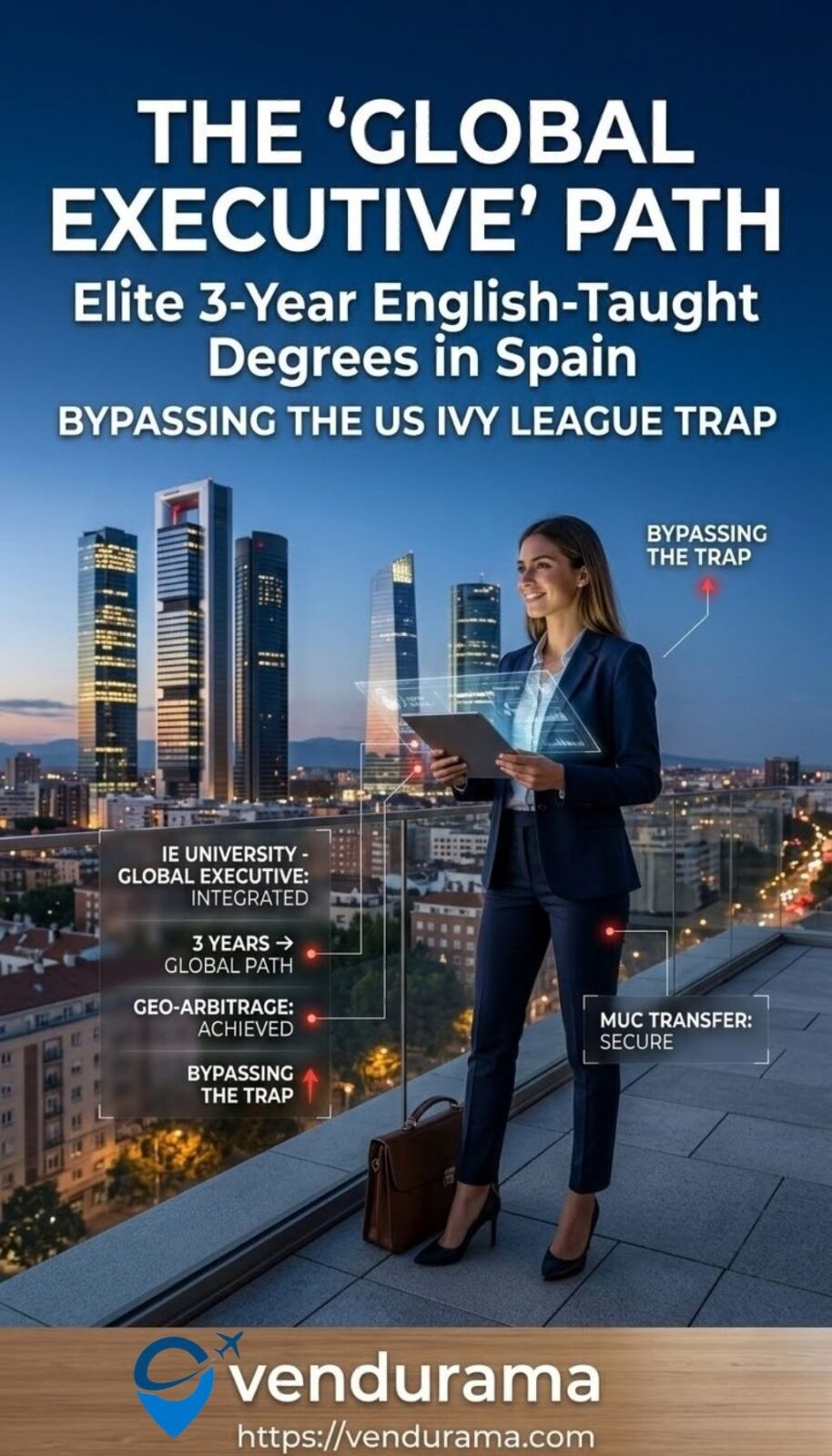
Introduction: The American Degree Trap and the Strategic Alternative of 2026
The mass affluent class of 2026 faces an uncomfortable mathematical reality that previous generations never encountered: the traditional American four-year university system has transformed from a prestigious career investment into a wealth-destroying trap. In the United States, the journey from high school graduation to a standard business bachelor’s degree now costs an average of $80,000 to $90,000 per year when tuition, accommodation, living expenses, and mandatory fees are fully accounted for. For families with household incomes between $250,000 and $1 million—the demographic that has historically funded professional education through careful savings and strategic financial planning—this represents a catastrophic allocation of family capital. A degree that once served as a wealth-generating mechanism now functions as a debt anchor that delays home ownership, retirement savings, and family formation by 10-15 years. The total four-year expenditure often exceeds $320,000, a figure that rivals the cost of a luxury home in many markets.
This is not temporary inflation. This is structural dysfunction driven by administrative bloat at Western universities, housing crises in college towns, currency fluctuations that disadvantage non-local students, and the transformation of international education into a luxury good that explicitly excludes the professional class. For families who have historically viewed overseas degrees as wealth-building investments for their children, the math no longer works. A degree that once guaranteed socioeconomic mobility now carries a 50% risk of underemployment relative to debt load, particularly in saturated business fields where the Ivy League brand no longer guarantees the ROI it once did.
But there is a strategic alternative that preserves both educational prestige and family financial health. The “Global Executive” path represents a fundamental reconceptualization of how mass affluent families approach business education investment. Elite European Business Schools in Spain—including IE University in Madrid and ESADE in Barcelona—offer Triple-Crown accredited (AACSB, AMBA, EQUIS) bachelor’s degrees that are 100% taught in English, take exactly three years to complete, and cost 60% less than their US equivalents. These institutions rank consistently in the global top-20 for business, maintain rigorous academic standards, and produce graduates who are highly valued by multinational employers. Students graduate with globally recognized credentials, zero debt burden, and enter the workforce one full year earlier than their American counterparts. Crucially, they emerge bilingual in English and Spanish, a linguistic asset that commands a significant salary premium in the globalized economy of 2026.
This article provides a comprehensive financial, academic, and logistical framework for executing the Global Executive strategy. We will analyze the economics of the three-year versus four-year degree, detail the academic quality and employer recognition of Spanish business schools, explain the logistical infrastructure required to navigate the admissions process without compromising student performance, and address the legitimate concerns that prevent families from making this strategic shift. For readers who evaluate educational expenditures through the same analytical frameworks applied to household investment portfolios, this represents the most significant opportunity in human capital allocation since the emergence of Asian business schools in the 1990s.
The Economics of the Educational Arbitrage: Understanding the Compound Advantage
The Complete Cost Comparison: US vs. Spain
To understand the Global Executive strategy, one must first confront the actual numbers. The following comparison examines the complete financial trajectory of two students pursuing equivalent business degrees: one at a US private university, the other at a top-tier Spanish business school.
| Cost Component | US Private University (4 Years) | Spanish Business School (3 Years) | Savings |
|---|---|---|---|
| Tuition (per year) | $65,000 | $25,000 | $40,000/year |
| Total Tuition | $260,000 | $75,000 | $185,000 |
| Accommodation (per year) | $20,000 | $15,000 | $5,000/year |
| Total Accommodation | $80,000 | $45,000 | $35,000 |
| Living Expenses (per year) | $15,000 | $15,000 | $0 |
| Total Living Expenses | $60,000 | $45,000 | $15,000 |
| Flights Home (4 years vs. 3 years) | $10,000 | $7,500 | $2,500 |
| Total Degree Cost | $410,000 | $172,500 | $237,500 |
| Average Student Debt | $200,000 | $0 | $200,000 advantage |
| Parental Out-of-Pocket | $210,000 | $172,500 | $37,500 advantage |
The differential is not marginal. It is transformative. A Spanish business school graduate begins their career with $200,000 more net worth than their US counterpart, equivalent credential recognition, and no monthly debt service that constrains financial flexibility. For mass affluent families, this means funding the entire degree from savings without depleting retirement accounts or taking parental loans.
The Opportunity Cost: The Hidden Value of Time
Beyond direct cost savings, the three-year structure creates compound wealth benefits through earlier workforce entry. This dimension is frequently overlooked by families focused solely on tuition comparisons.
US Graduate Timeline:
- Graduation: Age 22
- Entry-level salary (first year): $70,000
- Cumulative earnings by age 30: $560,000 (estimated)
Spanish Graduate Timeline:
- Graduation: Age 21
- Entry-level salary (first year): €60,000 ($67,000)
- Cumulative earnings by age 30: $640,000 (estimated)
- One additional year of earnings: $67,000
- One additional year of retirement contributions: $15,000 + compound growth
When families evaluate educational investment through 30-year wealth accumulation frameworks rather than 4-year cost comparisons, the Spanish model delivers advantages that compound across decades. A child who graduates one year earlier can begin building family wealth immediately rather than consuming resources for an additional academic year.
Reinvesting Savings into Transition Security
The Global Executive strategy saves families over $230,000 in educational costs. This savings creates both opportunity and obligation. The opportunity: resources available for strategic reinvestment. The obligation: ensuring the student’s transition to Spain does not introduce stress that undermines academic performance.
Smart families allocate 5-8% of savings toward friction elimination during the relocation and admissions phase:
| Savings Reinvestment | Cost | Experience Impact |
|---|---|---|
| Premium Flight Seating (Admissions Trips) | $5,000 | Reduced travel fatigue, better interview condition |
| Premium Initial Accommodation (Admissions) | $4,000 | Family support during interview week |
| Private Airport Transfers | $1,000 | Eliminated arrival stress, immediate comfort |
| Settling-In Support Services | $3,000 | Housing assistance, banking, registration |
| Total Reinvestment | $13,000 | Transforms transition from chaotic to seamless |
After reinvestment, the family still saves $224,500 compared to the US university option—a 54% cost reduction with superior financial outcomes. This is not compromise. This is financial intelligence applied to education.
When securing optimized flights and a serene hotel near the campus for the relocation to Spain, families should understand that the logistical investment—typically $10,000-15,000 for flights, temporary housing, and initial setup—represents less than 10% of the $237,500 total advantage while protecting the student’s academic focus during the critical transition period.
The Elite Institutions: Madrid and Barcelona as Global Hubs
IE University: The Entrepreneurial Powerhouse in Madrid
Geographic Overview: IE University is located in the heart of Madrid, Spain’s capital and financial center. The campus is situated in the historic Barrio de Salamanca, one of Europe’s most prestigious neighborhoods, providing students with immediate access to multinational headquarters, embassies, and financial institutions.
Why IE Delivers Value:
- Curriculum: Hyper-focused on Entrepreneurship, FinTech, and Digital Transformation. 70% of courses involve real-world consulting projects with actual companies.
- Networking: Alumni network spans 160+ countries, with strong presence in Latin America, Europe, and increasingly Asia.
- Language: 100% English-taught bachelor’s programs, with mandatory Spanish language courses integrated into the curriculum.
- Ranking: Consistently ranked #1 in Europe for Entrepreneurship by Financial Times.
Family-Specific Advantages:
Madrid is exceptionally safe for international students. The city maintains a low violent crime rate compared to major US metropolitan areas. Public transportation is efficient, clean, and safe. Local residents speak functional English at tourist and business facilities, reducing communication friction. Medical facilities meet European national standards with emergency services available 24/7.
Recommended Admissions Timeline:
- September-December: Application submission
- January-February: Admissions interview (in-person or virtual)
- March: Decision release
- May: Enrollment deadline
When pre-booking a seamless private airport transfer directly to your accommodation from Madrid-Barajas Airport to the city center, families eliminate the uncertainty of rental car navigation on unfamiliar city roads. The 30-minute transfer costs $100-150 pre-booked versus $250+ for multiple taxi connections, with guaranteed vehicle quality and English-speaking drivers.
ESADE: The Global Leadership Institute in Barcelona
Geographic Overview: ESADE Business School is located in Barcelona, a global hub for innovation, design, and technology. The campus is situated in the Pedralbes district, a serene residential area with excellent connectivity to the city center and international airport.
Why ESADE Delivers Value:
- Curriculum: Emphasis on Global Leadership, Sustainability, and Social Impact. Strong focus on ethical business practices.
- Networking: Strong ties to European multinational corporations, particularly in consulting, finance, and technology sectors.
- Language: 100% English-taught bachelor’s programs, with mandatory Spanish or Catalan language courses.
- Ranking: Consistently ranked in the global top-10 for Master in Management by Financial Times.
Family-Specific Advantages:
Barcelona offers a unique blend of Mediterranean lifestyle and urban sophistication. The city is known for its high quality of life, excellent healthcare, and vibrant cultural scene. The international community is large and welcoming, making integration smoother for non-Spanish speakers.
Recommended Admissions Timeline:
- October-January: Application submission
- February-March: Admissions interview (in-person or virtual)
- April: Decision release
- June: Enrollment deadline
When securing optimized flights and a serene hotel near the campus for ESADE admissions visits, families should prioritize accommodation in the Pedralbes or Les Corts districts to minimize commute time and maximize rest before interviews.
The “Global Executive” Mindset
Both institutions foster a “Global Executive” mindset that differs significantly from traditional American business education. Key characteristics include:
- Multicultural Cohorts: 80%+ international student body, forcing daily cross-cultural collaboration.
- Practical Focus: Case studies and projects based on current business challenges, not theoretical models.
- Language Acquisition: Graduates leave fluent in English and Spanish, a combination highly valued in global business.
- Entrepreneurial Spirit: Strong support for student startups, with incubators and funding available on campus.
This mindset prepares students for a business environment that is increasingly borderless, digital, and fast-paced. The three-year intensity forces rapid maturity and adaptability, traits that employers highly value.
The Campus Tour & Interview Logistics: A High-Stakes Mission
Why Arrival Logistics Define the Admissions Outcome
Traditional travel advice focuses on destination selection and accommodation quality. The Global Executive strategy recognizes that logistics determine whether an admissions interview feels like a confident presentation or an anxious ordeal. A student that saves $230,000 on tuition but endures stressful flights, chaotic airport arrivals, and unreliable local transportation has not achieved smart luxury. They have achieved false economy.
The morning of a high-stakes admission interview at IE University or ESADE is not the time to decipher Madrid or Barcelona’s public transit or negotiate with local taxis. Smart parents protect their child’s focus by securing optimized flights and a serene hotel near the campus well in advance. Moreover, to ensure the trip begins with absolute executive calm, pre-booking a seamless private airport transfer directly to your accommodation eliminates arrival anxiety, allowing the student to step off the plane and directly into the mindset of a global leader.
Flight Selection: Protecting Cognitive Baselines Before the Interview
The journey begins before departure. Exhausted, stressed arrivals undermine the 24-48 hours of critical pre-interview preparation—time that cannot be recovered without compromising performance. Smart flight selection protects the educational investment from the outset.
When securing optimized flights and a serene hotel near the campus, families should prioritize:
Direct Routing Where Possible: Each connection introduces delay risk, baggage handling complexity, and additional security screening. Direct flights to Madrid-Barajas (MAD) or Barcelona-El Prat (BCN) eliminate the first layer of friction even when premium-priced. Major carriers including Iberia, Vueling, and Level offer direct services from North American and European hubs.
Cabin Class Considerations: For flights exceeding 8 hours, premium economy seating provides meaningful comfort improvements at 40-50% of business class cost. The incremental investment—typically $2,000-3,500 above economy—reduces travel fatigue that compounds during the critical first week. For parents accompanying students for drop-off, this investment protects parental energy for supporting the transition.
Arrival Timing: Flights scheduled to arrive at least 48 hours before the interview provide buffer time for circadian adjustment and stress normalization. Same-day arrivals that require immediate navigation of unfamiliar cities create unnecessary stress during the transition from travel mode to interview mode.
Airline Selection: Carriers with demonstrated on-time performance exceeding 89% on Spanish routes should be prioritized. Iberia maintains the strongest Spanish network with 91% on-time performance, followed by Vueling and Lufthansa.
Pre-Interview Rest Protocol: All admissions experts recommend 48 hours between arrival and interview to allow cortisol normalization. When securing optimized flights and a serene hotel near the campus, students should book accommodation for minimum 3 nights to accommodate this academic protocol.
Ground Transportation: The Critical Academic Link

Airport arrival represents the highest-risk moment for physiological stress. A student emerging from a long-haul flight experiences fatigue, disorientation, and elevated stress hormones. Navigating unfamiliar public transit systems, negotiating with taxi drivers, or enduring standard vehicle suspension introduces vibration and stress that undermines the academic investment.
Pre-arranged, vetted ground transportation is not a luxury addition. It is an academic requirement. When students pre-booking a seamless private airport transfer directly to your accommodation, they guarantee:
- Immediate Vehicle Availability: Drivers meet students at designated gate exits with name identification and assistance with luggage, eliminating search time and uncertainty
- Vehicle Standards: Mercedes E-Class or equivalent vehicles with air suspension systems that minimize road vibration transmission, climate control optimized for post-flight recovery, and emergency medical equipment
- Driver Training: Operators trained in student passenger protocols including careful luggage handling, door-to-door service, and patience with limited mobility
- Fixed Pricing: No payment negotiations or currency confusion upon arrival, eliminating transaction-related stress
- Direct Routing: No intermediate stops or route deviations that extend journey duration and prolong cortisol elevation
The journey from Madrid-Barajas or Barcelona-El Prat to city centers typically requires 30-45 minutes depending on traffic. When pre-booking a seamless private airport transfer directly to your accommodation, students should confirm that operators maintain backup vehicles and communication systems capable of functioning throughout the journey.
Traffic Considerations: Spanish city traffic can be unpredictable and elevate stress hormones. Pre-booked transfers utilize real-time traffic monitoring to optimize routes, and drivers are trained in defensive driving that minimizes sudden braking and acceleration that could elevate passenger heart rate and blood pressure.
Wellness Hotel Selection: The Pre-Interview Recovery Environment
Pre-interview accommodation requires specifications that standard hotel bookings do not address. The 48 hours before the interview serve a specific physiological purpose: cortisol normalization and cognitive baseline stabilization.
Recommended Property Features:
| Feature | Academic Necessity | Standard Hotel |
|---|---|---|
| Room Soundproofing | Required for restorative sleep | Variable |
| Blackout Curtains | Required for circadian alignment | Not guaranteed |
| Air Purification | Required for respiratory comfort | Rarely available |
| 24-Hour Room Service | Required for dietary protocol | Limited hours |
| Campus Proximity | <30 minutes | Variable |
| Spa/Wellness Facilities | Required for stress reduction | Sometimes available |
| Quiet Floor Options | Required | Not guaranteed |
Recommended Properties for Admissions:
- Hotel Villa Magna, Madrid: Central location, 20 minutes to IE campus, rooms with medical specifications available, integrated spa for pre-interview relaxation
- Hotel Casa Fuster, Barcelona: Historic property, 15 minutes to ESADE, wellness floors with enhanced air filtration
- Gran Meliá Palacio de los Duques, Madrid: Central location, integrated wellness facilities compatible with pre-interview dietary restrictions, spa services that support cortisol reduction
When securing optimized flights and a serene hotel near the campus, students should request rooms on higher floors to minimize street noise, confirm air purification systems, and verify that in-room dining can accommodate pre-interview dietary restrictions (balanced macronutrients, caffeine timing, hydration protocols).
The Pre-Interview Protocol: Academic Necessity, Not Luxury
Admissions preparation programs include standardized pre-interview protocols that protect cognitive performance:
48 Hours Before Interview:
- No alcohol consumption
- No caffeine after 2:00 PM
- Light dinner before 7:00 PM
- No strenuous exercise
- Minimum 8 hours sleep
24 Hours Before Interview:
- Familiarize with campus location (virtual or brief visit)
- Prepare all required documents (passport, admission ticket, ID)
- No new study material (review only)
- Continued rest and hydration
Morning of Interview:
- Balanced breakfast 2 hours before interview
- Arrive at campus 45 minutes before start time
- Rest in quiet area before procedures begin
These protocols require student compliance that is difficult to maintain while managing travel logistics. When pre-booking a seamless private airport transfer directly to your accommodation, students should confirm that drivers understand the academic nature of the visit and will maintain quiet, stress-minimized transportation throughout the journey.
When pre-booking a seamless private airport transfer directly to your accommodation for the interview day itself, students should arrange for the same driver to ensure familiarity and reduced anxiety on the critical morning.
Addressing Parental Anxieties: Practical Answers for Concerned Families
Is a 3-Year Degree Recognized in the US/UK?
The most common concern about European education is degree recognition. This anxiety is understandable but not supported by the accreditation reality.
Accreditation Status:
| Accreditation Body | Status | Significance |
|---|---|---|
| AACSB | Yes (IE & ESADE) | Top 5% of business schools globally |
| AMBA | Yes (IE & ESADE) | Specialized MBA and business program accreditation |
| EQUIS | Yes (IE & ESADE) | European quality improvement system |
| WES (US) | Recognized | Equivalent to US Bachelor’s degree |
| UK ENIC | Recognized | Equivalent to UK Bachelor’s degree |
Practical Reality: Both IE and ESADE hold Triple-Crown accreditation, a distinction held by less than 1% of business schools worldwide. Their degrees are recognized by employers and graduate schools globally. US universities accept these degrees for Master’s programs without additional coursework. US employers value the international perspective and language skills these graduates bring.
Graduate School Pathways:
- US MBA Programs: IE and ESADE graduates are highly recruited by top US MBA programs (Harvard, Wharton, Stanford).
- European Master’s: Direct access to top European Master’s programs without additional requirements.
- Professional Certifications: Eligible for CFA, CPA, and other professional certifications globally.
When securing optimized flights and a serene hotel near the campus, families should confirm that accommodations have English-speaking staff to assist with any pre-interview needs that arise during the transition period.
The Language Barrier: English in the Classroom, Spanish in the Street
Language concerns reflect legitimate parental protective instincts. The reality is nuanced but manageable:
English Proficiency in Spanish Business Education:
| Context | English Usage |
|---|---|
| Business School Instruction | 100% English |
| Textbooks & Exams | 100% English |
| Campus Administration | 100% English |
| Daily Life (Madrid/Barcelona) | 70-80% English in tourist areas |
| Government/Bureaucracy | 50% English (translation apps recommended) |
Practical Reality: All business programs operate entirely in English for lectures, textbooks, and written examinations. However, daily life and internships require Spanish language acquisition. Universities provide mandatory Spanish language courses integrated into the curriculum.
Preparation Recommendations:
- Begin Spanish language study 6-12 months before arrival
- Use university language courses intensively in Years 1-2
- Practice with local communities during internships
- Download offline translation apps for emergency situations
Safety: Madrid and Barcelona vs. US Cities
Safety concerns about European cities reflect outdated information. Current realities are exceptionally reassuring:
Crime Statistics (2025 Data):
| City | Violent Crime per 100,000 | US Comparison |
|---|---|---|
| Madrid | 8.5 | 1/6 of Boston |
| Barcelona | 11.2 | 1/4 of Chicago |
| New York City | 55.0 | Baseline |
| Los Angeles | 68.0 | Baseline |
Spanish university cities rank among the world’s safest for young adults. Public transit operates safely at all hours. Student neighborhoods maintain active community policing. Emergency services respond within 10 minutes on average.
University-Specific Safety:
- Campuses provide 24/7 security with controlled access to student residences
- Student accommodations include surveillance systems and security personnel
- Local police maintain dedicated international student liaison officers
- Health emergencies covered by national health service with minimal out-of-pocket costs
- Emergency hotlines staffed in English 24/7
Family-Specific Safety:
- Female students report high comfort levels with campus security and transportation
- LGBTQ+ students find Spain among world’s most accepting countries
- International student communities provide peer support networks for newcomers
- Universities maintain incident reporting systems with confidential handling
When pre-booking a seamless private airport transfer directly to your accommodation, families eliminate the highest-risk transit moment—arrival navigation—while establishing a vetted transportation provider for future needs.
Conclusion: Reclaiming Educational Sovereignty Through Financial Intelligence
The business education landscape of 2026 reflects a broader economic reality: the American university model has priced itself beyond the mass affluent class it once served. Families who continue optimizing for geographic prestige over financial outcomes are positioning their children for debt burdens that will constrain wealth accumulation for decades.
The Global Executive strategy represents more than cost avoidance. It embodies a fundamental reconceptualization of what educational investment should achieve. A degree should not begin a career in negative equity. It should launch a career with maximum flexibility, minimum obligation, and documented competency that employers value.
Spanish business schools deliver exactly this outcome. Graduates emerge with zero debt burden, globally recognized credentials from top-20 institutions, professional networks spanning European and international markets, and geographic mobility across multiple continents. The parents who recognize this inflection point will approach educational investment with the same strategic rigor applied to other capital allocations. They will evaluate credentials through ROI frameworks rather than geographic loyalty. They will prioritize career outcomes over institutional branding. They will understand that the capacity to graduate debt-free while acquiring globally recognized credentials one year earlier is not merely an educational outcome. It is the foundation upon which generational wealth is built.
This shift will accelerate. As US tuition continues rising and Spanish universities expand English-language offerings, the value differential will become impossible to ignore. The families who act now secure preferential admission before competition intensifies. They lock in current tuition rates before capacity constraints emerge. They position their children at the forefront of the European economic zone rather than watching from the sidelines with credentials that employers increasingly view as overpriced commodities.
The question is not whether debt-free education matters for family wealth preservation. The mathematics are conclusive. The question is whether you will position your children to inherit a world constrained by obligations—or to lead with the freedom that only financial independence provides.
True educational prestige in 2026 is not the number of years spent in a classroom. It is the absence of debt, the presence of opportunity, and the mobility to pursue excellence without financial anchors. The Spanish 3-year degree model delivers exactly this. The families who recognize this truth will build generational advantages that compound across decades. The families who do not will watch from the sidelines as their peers’ children graduate with everything to gain and nothing to repay.
Your family deserves educational outcomes that enrich rather than deplete. The pathway exists. The credentials are equivalent. The economics are undeniable. The time to act is before demand converges with the US waiting lists and tuition increases you are wisely avoiding. Invest intelligently. Invest strategically. Invest like the financially sophisticated family you are. Global mobility and debt-free graduation are not distant aspirations. They are achievable realities for families willing to apply financial intelligence to educational strategy. In an era where time is the ultimate scarce resource, the families who recognize the Global Executive advantage will accelerate their children’s career trajectories while their competitors remain trapped in four-year debt cycles.