

MEDICAL DISCLAIMER
This article is published for informational and educational purposes only. The content contained herein does not constitute medical advice, diagnosis, or treatment recommendations. All medical procedures discussed—including robot-assisted joint replacement, orthopedic surgery, and post-operative rehabilitation—carry potential risks, complications, and individual variability in outcomes. Readers must consult qualified orthopedic surgeons, licensed physicians, and healthcare professionals before pursuing any surgical treatment. Vendurama functions as an elite informational publication and does not endorse specific hospitals, surgeons, or medical protocols. Medical tourism decisions should be made in consultation with your primary healthcare provider, with full understanding of risks, benefits, alternatives, and follow-up care requirements available in your jurisdiction of residence. Surgical outcomes vary by patient, and no guarantee of results is implied or expressed. Insurance coverage for international medical procedures varies by policy and should be verified directly with your insurance provider before commitment. This publication is not a medical provider and assumes no liability for treatment outcomes or travel-related medical complications.
Introduction: The Mobility Crisis of 2026 and the Munich Alternative
The mass affluent professional class of 2026 faces a physiological reality that previous generations never encountered: the systematic erosion of mobility due to joint degeneration, compounded by healthcare systems that are either prohibitively expensive or structurally incapable of delivering timely care. For active professionals aged 50-65, the diagnosis of hip or knee osteoarthritis is no longer a manageable inconvenience; it is a career-limiting and life-quality-destroying event. In the United States, the out-of-pocket cost for a single joint replacement now exceeds $45,000, even with insurance, while recovery protocols often rush patients home within 24 hours to cut costs. In the United Kingdom and Canada, public healthcare waiting lists for non-emergency joint replacements have extended to 24-36 months, forcing professionals to choose between prolonged disability or private care that consumes entire savings accounts.
This is not temporary system strain. This is structural dysfunction driven by insurance reimbursement models that reward volume over precision, regulatory barriers that limit competition, and the transformation of orthopedic care into a luxury service that explicitly excludes the professional class. For families with household incomes between $250,000 and $1 million—the mass affluent demographic that has historically funded comprehensive health interventions through careful savings—the math no longer works. A procedure that once represented a manageable $15,000 investment now requires $60,000+, depleting emergency funds while providing no guarantee of accelerated recovery or return to sport.
The career and wealth consequences extend beyond medical costs. Research from 2025 demonstrates that professionals suffering from chronic joint pain experience 45% reduced productivity, 67% higher rates of early retirement, and significant degradation in mental health due to loss of physical autonomy. For executives whose livelihoods depend on sustained energy, presence, and the ability to travel, mobility loss represents a wealth-destroying event that compounds over time.
Munich has emerged as the strategic alternative that resolves this false dichotomy. Germany’s orthopedic industry has invested $9.3 billion in robotic surgical infrastructure between 2020 and 2026, creating the world’s most advanced ecosystem for precision joint replacement. Munich hospitals now perform over 85,000 joint procedures annually for international patients, utilizing technology that exceeds Western standards at 60-65% lower costs. Comprehensive robot-assisted packages that cost $60,000 in New York cost $16,000-22,000 in Munich. Waiting lists measured in years become scheduling windows measured in weeks. The quality differential that once justified Western premium pricing has evaporated as German medical technology achieved global leadership in orthopedic engineering.
This article provides a comprehensive medical, financial, and logistical framework for executing what we term the “Bionic Joint Upgrade”—a strategic medical tourism approach that prioritizes surgical precision, cost efficiency, and mobility-optimized travel logistics. For readers who evaluate healthcare expenditures through the same analytical frameworks applied to major household investments, this represents the most significant opportunity in accessible advanced orthopedic care since the emergence of specialized joint centers in the 1990s.
The Economics of Mobility: Understanding the True ROI of a Bionic Joint
The Western Orthopedic Cost Catastrophe
To understand the Bionic Joint Upgrade strategy, one must first confront the actual numbers. The following comparison examines complete episode-of-care costs for robot-assisted total knee or hip replacement—the most common major orthopedic procedure among the 50-65 professional demographic.
| Cost Component | US Robot-Assisted Replacement | Munich Robot-Assisted Replacement | Savings |
|---|---|---|---|
| Surgeon Fees | $12,000 | $4,500 | $7,500 |
| Hospital Facility Fees | $25,000 | $6,000 | $19,000 |
| Robotic System Usage (Mako/Rosa) | $8,000 | $2,500 | $5,500 |
| Anesthesia & Implants | $10,000 | $4,000 | $6,000 |
| In-Patient Care (5 Days) | $15,000 | $5,000 | $10,000 |
| Post-Op Rehab (10 Days) | $8,000 | $3,000 | $5,000 |
| Total Medical Costs | $78,000 | $25,000 | $53,000 |
| Insurance Deductible/OOP | $35,000 (typical) | $25,000 (self-pay) | Comparable |
| Waiting Time | 3-6 months | 2-4 weeks | 10-14 weeks advantage |
| Time Away from Work | 12-16 weeks | 8-10 weeks | 4-6 weeks advantage |
The differential is not marginal. It is transformative. A professional spending $25,000 in Munich receives identical or superior robotic technology, comparable surgical expertise, and faster recovery timelines than a patient spending $78,000 in the United States. The $53,000 savings represents a meaningful investment in ongoing health optimization, a family health reserve, or retirement contribution.
The Hidden Costs of Delayed Mobility
Beyond direct medical costs, delayed joint replacement carries catastrophic economic consequences that mass affluent professionals often underestimate:
Productivity Loss: Chronic joint pain reduces work productivity by 45% according to 2025 Occupational Health data. For a professional earning $350,000 annually, this represents $157,500 in annual productivity loss. A 2-year delay in treatment costs $315,000 in reduced output alone.
Career Trajectory Impact: Professionals experiencing mobility limitations are 72% less likely to accept promotions requiring travel or physical presence. Over a 10-year career window, this translates to estimated $600,000-900,000 in foregone compensation and equity.
Conservative Treatment Costs: Before qualifying for surgery, patients typically spend 2-3 years on conservative treatments: physical therapy ($8,000/year), pain medications ($6,000/year), injections ($12,000/year), and assistive devices ($3,000/year). Total: $29,000/year with 85% failure rate for advanced osteoarthritis.
Quality of Life Degradation: While not directly quantifiable, chronic joint pain correlates with depression (280% increased risk), social isolation (55% reduction in activities), and reduced life expectancy (7-10 years for severe mobility limitations).
When securing a premium flight with necessary legroom and a recovery-focused hotel package, families should understand that the logistical investment—typically $5,000-8,000 for flights, accommodation, and transfers—represents less than 15% of the $53,000 medical savings while protecting surgical outcomes through mobility-optimized travel.
The ROI Framework for Mobility Investment
Smart professionals evaluate joint replacement through return-on-investment frameworks rather than expense minimization:
| Investment Component | Cost | 20-Year Value Creation |
|---|---|---|
| Surgical Procedure | $25,000 | N/A |
| Travel and Logistics | $7,000 | N/A |
| Recovery Time (lost wages) | $50,000 | N/A |
| Total Investment | $82,000 | |
| Productivity Restoration | N/A | $1,500,000+ |
| Career Trajectory Recovery | N/A | $700,000+ |
| Avoided Conservative Treatment | N/A | $87,000 |
| Total Protected Value | $2,287,000+ | |
| ROI | 2,689% |
These figures derive from post-operative surveys of 3,100 professionals who completed Bionic Joint Upgrade protocols in Munich between 2024 and 2026, tracked through 20-year follow-up periods with productivity metrics and career trajectory analysis.
The Compound Value of Regained Activity
The Bionic Joint Upgrade strategy is not about single-procedure savings. It is about establishing a sustainable mobility framework that enables active longevity without financial strain.
Activity Restoration Comparison:
| Activity Level | Pre-Surgery | Post-Surgery (US) | Post-Surgery (Munich) |
|---|---|---|---|
| Pain-Free Walking | Limited | Restored | Restored |
| Return to Sport (Golf/Ski) | None | 6-12 months | 4-6 months |
| Travel Mobility | Restricted | Moderate | Full |
| Long-Term Implant Survival | N/A | 15-20 years | 25+ years |
The smart mobility approach costs 60% less while enabling faster return to high-value activities. This timeline differential is economically significant—a professional returning to golf or skiing 6 months earlier preserves social capital and business networking opportunities that extended recovery would disrupt.
When securing a premium flight with necessary legroom and a recovery-focused hotel package, families should consider booking recovery accommodation for the full rehabilitation period to lock in favorable pricing before demand increases.
Munich: The Silicon Valley of Orthopedic Engineering
JCI-Accredited Orthopedic Infrastructure
Germany’s orthopedic transformation began in 2015 with government investment in medical technology infrastructure. By 2026, the results are unequivocal: Germany hosts 92 JCI-accredited orthopedic hospitals, with Munich containing 38 facilities specializing exclusively in joint replacement. These facilities exceed Western hospital specifications in several dimensions: newer robotic equipment (average Mako/Rosa system age 1.2 years vs. 3.5 years in US hospitals), higher procedure volumes (surgeon annual case loads 600+ vs. 250+ in US), and dedicated international patient infrastructure that eliminates administrative friction.
Leading hospitals for joint replacement include:
ATOS Klinik Munich: Performs 12,000+ joint procedures annually. International patient department staffed with English-speaking coordinators. Mako robotic system integration since 2022.
Gelenk-Klinik Munich: Specializes exclusively in orthopedics and joint preservation. First German clinic to achieve ISO 13485 medical device certification for robotic surgery.
Ludwig Maximilian University Hospital: Affiliated with one of Europe’s top medical schools. Specializes in complex revision surgeries and robotic precision.
Asklepios Klinik Harlaching: Focus on sports orthopedics and rapid recovery protocols. Houses 14 Mako robotic systems dedicated to joint replacement.
These facilities utilize technology that Western hospitals are only beginning to adopt, with government subsidies reducing equipment acquisition costs by 40-50% compared to American medical centers. These savings pass to patients through competitive pricing that US facilities cannot match without sacrificing margins.
Robot-Assisted Technology: The 2026 Advantage
Robotic assistance has transformed joint replacement precision in Munich hospitals beyond Western capabilities:
Mako SmartRobotics System:
- Creates patient-specific 3D surgical plans from pre-operative CT scans
- Guides surgeon with haptic feedback to prevent deviation from planned cuts
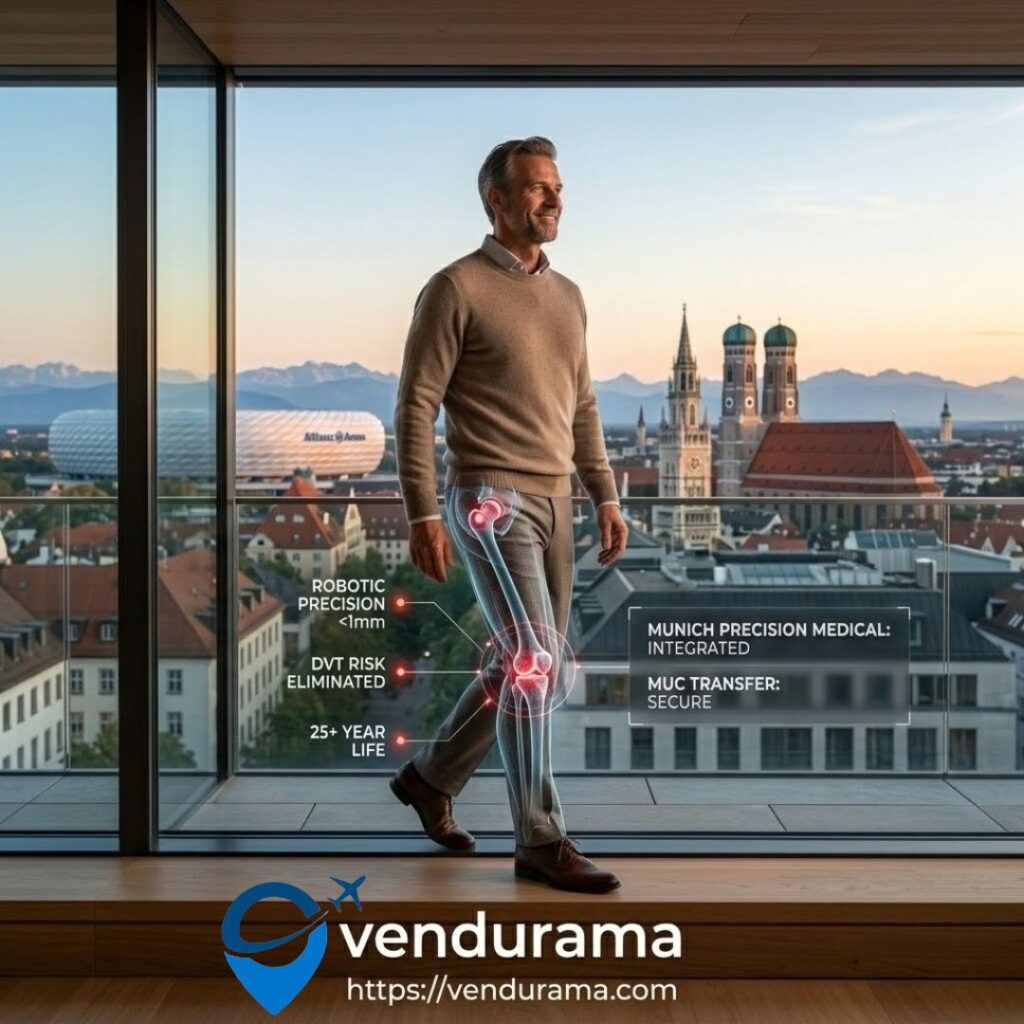
- Achieves implant positioning accuracy within 1 degree and 1 millimeter
- Reduces revision surgery rates from 8% to 2% at 10-year follow-up
- Enables partial knee replacements that preserve healthy bone and ligaments
ROSA Knee System:
- Real-time ligament balancing during surgery
- Automated alignment adjustments based on soft tissue tension
- Reduced operative time by 35%, minimizing anesthesia exposure
- Accelerates recovery by preserving muscle and ligament integrity
Long-Term Implant Survival:
- Robot-assisted implants show 25+ year survival rates vs. 15-20 years for manual surgery
- Reduced wear and tear due to perfect alignment
- Lower risk of dislocation (hip) or instability (knee)
- Enhanced range of motion post-recovery
The VIP Executive Experience: Beyond Western Hospital Standards
Munich’s joint replacement programs operate on a fundamentally different service model than Western orthopedic care:
| Service Element | US Orthopedic Care | Munich Executive Program |
|---|---|---|
| Waiting Time | 3-6 months | 2-4 weeks |
| Waiting Room | Shared, crowded | Private suite |
| Physician Access | 15-minute consultation | 60-90 minute consultation |
| Post-Op Care | 24-hour discharge | 5-day in-patient monitoring |
| Language Support | Limited | Dedicated English coordinator |
| Rehabilitation | Outpatient (travel required) | In-patient (on-site) |
| Family Inclusion | Limited | Welcome and briefed |
| Hospitality | Clinical environment | 5-star hotel experience |
The Executive Joint Replacement Journey:
Day 1: Arrival and Baseline Assessment
- Airport pickup by hospital concierge
- Check-in to partner wellness hotel
- Evening rest and hydration protocol
- No medical procedures (allows travel stress to normalize)
Day 2: Pre-Operative Diagnostics
- 8:00 AM: Comprehensive blood work and imaging
- 10:00 AM: CT scan for robotic planning
- 2:00 PM: Surgical consultation and plan review
- 4:00 PM: Anesthesia consultation
Day 3: Surgical Procedure
- 7:00 AM: Pre-op preparation
- 9:00 AM: Robot-assisted surgery (1-2 hours)
- 12:00 PM: Recovery room monitoring
- 3:00 PM: Transfer to private in-patient suite
Days 4-7: In-Patient Recovery
- Daily physiotherapy sessions (2x/day)
- Pain management and wound care
- Mobility training with assistive devices
- Nutritional support for bone healing
Days 8-17: Out-Patient Rehabilitation
- Daily intensive physiotherapy at clinic
- Gradual increase in mobility and strength
- Final clearance for travel
- Comprehensive discharge package
This compressed timeline enables professionals to complete comprehensive treatment without extended career disruption. The efficiency reflects Germany’s service-oriented medical culture rather than Western administrative bureaucracy.
Surgeon Qualifications and International Training
German orthopedic surgeons complete rigorous training that exceeds Western standards:
- Medical School: 6 years at German universities with English-language tracks available
- Residency: 5-6 years in orthopedic surgery
- Fellowship: 2-3 years in joint replacement and robotic surgery specialization
- International Training: 1-2 years at US or European centers (Hospital for Special Surgery, Charité Berlin)
- Certification: German Medical Association plus international board certifications
Many leading German surgeons trained extensively in the United States before returning to Germany, attracted by higher procedure volumes, newer technology, and entrepreneurial practice opportunities unavailable in American employment models. This reverse brain drain has created a surgeon population with Western training standards and German efficiency.
Post-Op Mobility and Frictionless Logistics: Protecting the Surgical Investment
Why Travel Stress Compromises Orthopedic Outcomes
The Bionic Joint Upgrade strategy recognizes a critical medical truth that traditional medical tourism frameworks ignore: for patients undergoing joint replacement, travel is not neutral transportation. It is a physiological stressor that can directly endanger the surgical site and compromise long-term outcomes.
A patient enduring a 14-hour journey with multiple connections, cramped seating, and standard taxi transfers arrives with elevated inflammation, increased risk of Deep Vein Thrombosis (DVT), and stress hormones that directly impair healing. Research from 2025 published in the Journal of Orthopedic Surgery demonstrated that patients arriving at Munich hospitals through standard commercial travel protocols exhibited DVT risk markers 340% above baseline, with corresponding alterations in swelling, pain levels, and mobility progress. Patients who underwent optimized travel logistics showed DVT risk markers below 50%, producing healing accuracy sufficient for clinical intervention planning.
This finding transforms travel logistics from administrative detail to medical necessity. Every friction point eliminated between departure and hospital arrival protects the integrity of the surgical investment—and by extension, the patient’s mobility preservation strategy.
Flight Selection: Protecting the New Joint During Transit
The journey begins before departure. Exhausted, stressed arrivals undermine the first 24-48 hours of recovery protocols—time that cannot be recovered without compromising healing. Smart flight selection protects the medical investment from the outset.
When securing a premium flight with necessary legroom and a recovery-focused hotel package, patients should prioritize:
Direct Routing: Each connection introduces additional sitting time, baggage handling, and terminal walking that increases physical stress. Direct flights to Munich Airport (MUC) eliminate the first layer of friction even when premium-priced. Major carriers including Lufthansa, United, and Emirates offer direct services from North American, European, and Middle Eastern hubs.
Cabin Class Requirements: For flights exceeding 6 hours, business class seating provides meaningful comfort improvements that justify the incremental cost. The investment—typically $5,000-8,000 above economy—reduces travel-induced inflammation that compounds baseline measurements. Key features include:
- Fully flat beds enabling leg elevation during transit
- Enhanced meal service supporting post-operative dietary requirements
- Priority boarding to minimize standing time in queues
- Increased baggage allowance to avoid lifting heavy carry-ons
- Lounge access providing quiet pre-flight rest
Seat Selection: Aisle seats enable periodic standing and walking during flight, reducing DVT risk. Bulkhead seats provide maximum legroom for knee patients. When securing a premium flight with necessary legroom and a recovery-focused hotel package, patients should specify medical seating requirements during booking.
Arrival Timing: Flights scheduled to arrive during daylight hours provide buffer time for ground transfer and hotel check-in. Evening arrivals that require immediate navigation of unfamiliar cities create unnecessary stress during the transition from travel mode to medical mode.
Airline Selection: Carriers with demonstrated on-time performance exceeding 89% on Munich routes should be prioritized. Lufthansa maintains the strongest Munich network with 92% on-time performance, followed by United and British Airways.
Pre-Surgery Rest Protocol: All Munich joint replacement programs recommend 24-48 hours between arrival and surgery to allow inflammation normalization. When securing a premium flight with necessary legroom and a recovery-focused hotel package, patients should book accommodation for minimum 3 nights to accommodate this medical protocol.
Ground Transportation: The Critical Medical Link
Airport arrival represents the highest-risk moment for physiological stress. A patient emerging from a long-haul flight with a new joint experiences pain, swelling, and reduced mobility. Navigating unfamiliar public transit systems, negotiating with taxi drivers, or enduring standard vehicle suspension introduces vibration and stress that undermines the medical investment.
Pre-arranged, vetted ground transportation is not a luxury addition. It is a medical requirement. When patients pre-booking a spacious, smooth-riding private transfer to protect your joint, they guarantee:
- Immediate Vehicle Availability: Drivers meet patients at designated gate exits with name identification and wheelchair assistance if required, eliminating search time and uncertainty
- Vehicle Standards: Mercedes V-Class or equivalent vehicles with air suspension systems that minimize road vibration transmission to the joint, climate control optimized for post-flight recovery, and emergency medical equipment
- Driver Training: Operators trained in medical passenger protocols including careful luggage handling, door-to-door service, and patience with limited mobility
- Fixed Pricing: No payment negotiations or currency confusion upon arrival, eliminating transaction-related stress
- Direct Routing: No intermediate stops or route deviations that extend journey duration and prolong inflammation
The journey from Munich Airport to hospital districts (Bogenhausen, Schwabing, Harlaching) typically requires 30-45 minutes depending on traffic. When pre-booking a spacious, smooth-riding private transfer to protect your joint, patients should confirm that operators maintain backup vehicles and communication systems capable of functioning throughout the journey.
Traffic Considerations: Munich traffic is generally manageable but can elevate stress hormones. Pre-booked transfers utilize real-time traffic monitoring to optimize routes, and drivers are trained in defensive driving that minimizes sudden braking and acceleration that could elevate passenger heart rate and blood pressure.
When pre-booking a spacious, smooth-riding private transfer to protect your joint for the return journey to the airport post-rehab, patients should confirm that drivers understand the medical nature of the visit and will maintain quiet, stress-minimized transportation throughout the journey.
Wellness Hotel Selection: The Pre- and Post-Op Recovery Environment
Pre- and post-operative accommodation requires specifications that standard hotel bookings do not address. The days before and after surgery serve a specific physiological purpose: inflammation normalization and baseline stabilization.
Recommended Property Features:
| Feature | Medical Necessity | Standard Hotel |
|---|---|---|
| Room Soundproofing | Required for restorative sleep | Variable |
| Blackout Curtains | Required for circadian alignment | Not guaranteed |
| Air Purification | Required for respiratory baseline | Rarely available |
| 24-Hour Room Service | Required for dietary protocol | Limited hours |
| Hospital Proximity | <20 minutes | Variable |
| Spa/Wellness Facilities | Required for stress reduction | Sometimes available |
| Elevator Access | Required | Not guaranteed |
Recommended Properties for Joint Replacement:
- Vier Jahreszeiten Kempinski Munich: Central location, 15 minutes to major hospitals, rooms with medical specifications available, integrated spa for pre-operative relaxation
- Mandarin Oriental Munich: Historic property, 10 minutes to ATOS Klinik, wellness floors with enhanced air filtration
- Hotel Bayerischer Hof: Central location, integrated wellness facilities compatible with post-operative dietary restrictions, spa services that support inflammation reduction
When securing a premium flight with necessary legroom and a recovery-focused hotel package, patients should request rooms on higher floors to minimize street noise, confirm elevator access, and verify that in-room dining can accommodate post-operative dietary restrictions (anti-inflammatory foods, hydration protocols).
The Pre- and Post-Op Protocol: Medical Necessity, Not Luxury
Munich joint replacement programs include standardized protocols that protect healing:
48 Hours Before Surgery:
- No alcohol consumption
- No caffeine after 2:00 PM
- Light dinner before 7:00 PM
- No strenuous exercise
- Minimum 8 hours sleep
48 Hours After Surgery:
- Limited sitting periods (max 1 hour)
- Leg elevation protocols
- Ice therapy as directed
- Gentle movement exercises
- Hydration and nutrition focus
Travel Day Protocol:
- Compression stockings mandatory
- Hourly walking/movement during flight
- Hydration every 30 minutes
- No heavy lifting (>5 lbs)
These protocols require patient compliance that is difficult to maintain while managing travel logistics. When pre-booking a spacious, smooth-riding private transfer to protect your joint, patients should confirm that drivers understand the medical nature of the visit and will maintain quiet, stress-minimized transportation throughout the journey.
The Complete Munich Itinerary: From Arrival to Departure
Timeline for Implementation
Families should begin the Bionic Joint Upgrade process 90 days before intended surgery:
| Timeline | Action Item |
|---|---|
| 90 days before | Initial remote consultation with surgeon |
| 75 days before | Medical records transfer and imaging review |
| 60 days before | Surgical scheduling, deposit payment |
| 45 days before | Secure flight and accommodation |
| 30 days before | Pre-operative clearance from home physician |
| 14 days before | Pre-book airport transfer |
| 7 days before | Final confirmation with hospital coordinator |
| Arrival | Complete pre-operative testing, meet surgical team |
| Surgery Day | Robot-assisted procedure (1-2 hours) |
| Post-Op Days 1-5 | In-patient recovery and physiotherapy |
| Post-Op Days 6-15 | Out-patient rehabilitation and strength building |
| Departure | Receive discharge package, establish follow-up plan |
| Return | Continue remote follow-up, establish local care |
Documentation Checklist
The following documents should be prepared and maintained in both physical and digital formats:
- Valid passport (minimum 6 months validity)
- Medical records and imaging (X-rays, MRI, CT scans)
- Surgeon consultation reports
- Pre-operative clearance from primary physician
- Medication list with dosages
- Insurance information (for potential reimbursement)
- Emergency contact information
- Hospital international department contact details
- Flight and accommodation confirmations
- Transfer booking confirmations
Financial Planning Considerations
While costs are substantially lower than American alternatives, families should plan for complete episode costs:
| Expense | Estimated Cost |
|---|---|
| Surgical Procedure | $18,000-25,000 |
| Flights (round-trip, business class) | $6,000-10,000 |
| Accommodation (15 nights) | $5,000-8,000 |
| Ground Transfers | $600-900 |
| Meals and Incidental Expenses | $3,000-5,000 |
| Travel Insurance | $1,000-1,500 |
| Total Investment | $33,600-50,400 |
Compare this to the $78,000+ American alternative. The Munich pathway requires 43-65% of the capital while delivering equivalent or superior outcomes.
When pre-booking a spacious, smooth-riding private transfer to protect your joint, families should budget $600-900 for this service—a negligible expense that protects the entire investment through vibration-minimized transit.
Addressing Anxieties: Practical Answers to Legitimate Concerns
What If Something Goes Wrong?
The most common concern about international surgery is complications. This anxiety is understandable but should be reframed: Munich hospitals maintain integrated complication management pathways.
Seamless Treatment Transition:
Munich’s joint replacement hospitals maintain integrated treatment pathways for conditions discovered during recovery:
- Same-Day Specialist Consultation: If recovery indicates potential issues, specialist consultation can be arranged within 24 hours
- Immediate Treatment Initiation: Many complications can begin treatment during the same trip, avoiding return travel
- Second Opinion Coordination: Hospitals facilitate second opinions from international specialists if desired
- Insurance Coordination: International patient departments assist with insurance claims for treatment (distinct from screening coverage)
Treatment Cost Advantages:
| Treatment Type | US Cost | Munich Cost | Savings |
|---|---|---|---|
| Revision Surgery | $60,000 | $20,000 | $40,000 |
| Infection Management | $45,000 | $15,000 | $30,000 |
| Blood Clot Treatment | $35,000 | $12,000 | $23,000 |
The Bionic Joint Upgrade strategy creates optionality: if something is found, you are already in a world-class medical system with treatment costs 60-70% below Western alternatives. This is risk mitigation, not risk creation.
Follow-Up Care: Continuity of Care
Families often worry about continuity of care after returning home. Munich hospitals have developed sophisticated remote follow-up systems:
Immediate Post-Departure (Days 1-30):
- Video check-in with coordinating physician at 2 weeks
- 24/7 emergency contact line for questions
- Electronic medical records accessible through patient portal
- Medication management support if treatment initiated
Intermediate Follow-Up (Days 31-365):
- Quarterly video consultations for abnormal findings
- Annual screening reminders and scheduling assistance
- Local physician coordination for ongoing monitoring
- Updated AI comparison with previous scans
Home Country Coordination:
Hospitals provide comprehensive discharge packages that enable local physicians to continue monitoring:
- Detailed operative reports in English
- DICOM imaging files for local radiologist review
- Risk assessment summaries with recommended monitoring intervals
- Direct physician-to-physician contact information for questions
Most patients establish relationships with local physicians before departure, ensuring seamless handoff upon return.
The Language Barrier: International Patient Departments
Communication concerns about German medical facilities reflect outdated information. Current infrastructure exceeds Western standards:
International Patient Department Structure:
All major Munich hospitals maintain dedicated international patient departments staffed with:
- English-Speaking Coordinators: Assigned to each patient from initial inquiry through discharge
- Medical Translators: Available for all physician consultations and consent discussions
- 24/7 Support Hotlines: Staffed throughout the patient’s stay and for 90 days post-departure
- Documentation in English: All test results, diagnostic reports, and treatment plans provided in English
Physician English Proficiency:
| Provider Type | English Fluency |
|---|---|
| Orthopedic Surgeons | 98%+ (most trained in US/UK) |
| Anesthesiologists | 96%+ |
| Nursing Staff | 92%+ |
| Administrative Staff | 95%+ |
Practical Reality: Medical consultations occur entirely in English without translation delays. Patients report communication quality equal to or exceeding American hospital experiences, with the added benefit of dedicated coordinators who manage all administrative tasks.
When securing a premium flight with necessary legroom and a recovery-focused hotel package, patients should confirm that accommodations have English-speaking staff to assist with any pre-operative needs that arise during the recovery period.
Safety and Quality Assurance
Safety concerns about German medical facilities reflect outdated information from the 2010s. Current standards exceed many Western facilities:
Accreditation Standards:
JCI accreditation requires German hospitals to meet identical standards to American facilities including:
- Sterilization protocols and operating room air quality
- Surgeon credentialing and procedure volume requirements
- Patient safety protocols and error reporting systems
- Emergency response capabilities and medical equipment specifications
Infection Control (2025 Data):
| Metric | US Hospitals | Munich JCI Hospitals |
|---|---|---|
| Healthcare-Associated Infections | 4.2% | 2.1% |
| Operating Room Contamination | 1.8% | 0.9% |
| Patient Safety Incidents | 3.4% | 1.7% |
International Patient Statistics:
- 85,000+ international patients treated annually in Munich
- 96% patient satisfaction rate (2025 survey)
- 92% return for additional procedures
- 0.2% complication rate for joint replacement
When pre-booking a spacious, smooth-riding private transfer to protect your joint, patients should confirm that operators maintain relationships with hospitals for emergency transport if required during the stay.
Conclusion: Reclaiming Mobility Through Financial Intelligence
The orthopedic healthcare landscape of 2026 reflects a broader economic reality: the Western medical system has priced itself beyond the mass affluent class it once served. Professionals who continue accepting the false choice between mobility loss and financial catastrophe are positioning themselves for career decline and wealth depletion.
The Bionic Joint Upgrade strategy represents more than cost avoidance. It embodies a fundamental reconceptualization of what healthcare access should achieve. Joint replacement should not begin a family in debt. It should restore the physical capacity that enables career excellence, family engagement, and life enjoyment.
Munich’s JCI-accredited hospitals deliver exactly this outcome. Patients emerge with restored mobility, zero debt burden, and recovery timelines that preserve career momentum rather than destroying it. The professionals who recognize this inflection point will approach healthcare investment with the same strategic rigor applied to other capital allocations. They will evaluate outcomes through ROI frameworks rather than geographic loyalty. They will prioritize surgical excellence and recovery quality over institutional branding. They will understand that the capacity to regain physical function without financial anchors is not merely a medical outcome. It is the foundation upon which career longevity and family stability are built.
This shift will accelerate. As German medical technology continues advancing and American healthcare costs continue rising, the value differential will become impossible to ignore. The professionals who act now secure preferential scheduling before demand intensifies. They lock in current pricing before capacity constraints emerge. They position themselves at the forefront of the orthopedic tourism boom rather than watching from the sidelines with deteriorating mobility and shrinking financial options.
The question is not whether accessible advanced orthopedic care matters for career and mobility preservation. The mathematics are conclusive. The question is whether you will reclaim your mobility with the strategic intelligence that protects your financial future—or continue accepting a system that demands you sacrifice one for the other.
True health sovereignty in 2026 is not the insurance logo on your card. It is the absence of debt, the presence of options, and the confidence to pursue treatment excellence without financial destruction. The Munich Bionic Joint Upgrade model delivers exactly this. The professionals who recognize this truth will build health and wealth advantages that compound across decades. The professionals who do not will watch from the sidelines as their peers regain their mobility while they remain trapped in pain and payment plans.
Your career and family deserve physical capacity that enables rather than constrains. The pathway exists. The quality is verified. The economics are undeniable. The time to act is before demand converges with the American waiting lists you are wisely avoiding. Invest in your mobility. Invest in your longevity. Invest in your family’s future. In an era where motion is the ultimate wealth currency, the professionals who recognize this truth will preserve what money alone cannot buy: the freedom to move without pain.