
Introduction: When Heat Becomes the Enemy and Cold Becomes the Asset
Summer 2026 has rewritten the geography of luxury travel. The Mediterranean recorded its twelfth consecutive month of temperatures exceeding 42°C, with coastal resorts in Greece, Italy, and southern France implementing mandatory midday curfews as heat-related hospitalizations overwhelmed local medical infrastructure. The Caribbean, once the default sanctuary for Northern Hemisphere winter escape, now faces hurricane seasons that extend from June through November, with sea surface temperatures 3.2°C above historical averages fueling storms of unprecedented intensity.
For the mass affluent and ultra-high-net-worth demographics, this climatic inversion has produced a fundamental reassessment of what constitutes luxury travel. The traditional markers—beachfront villas, sun-drenched decks, tropical warmth—have transformed from assets into liabilities. The new ultimate status symbol is not access to heat, but escape from it. The new psychological sanctuary is not the tropical island, but the extreme latitude where temperatures remain below 10°C even at summer solstice.
Svalbard has emerged as the epicenter of this latitude arbitrage. The Norwegian archipelago, positioned at 74° to 81° north latitude, offers something that no traditional luxury destination can provide: guaranteed thermal relief, absolute darkness during winter months, and an ecosystem so remote that fewer than 3,000 permanent residents inhabit the entire territory. For executives whose cognitive function has been degraded by months of heat exposure, sleep disruption from tropical humidity, and the psychological fatigue of climate anxiety, Svalbard represents not a vacation but a physiological reset.
This article examines the psychological imperatives driving elite demand for Arctic expedition yachting, the economic architecture of ice-class luxury vessels, the logistical infrastructure required to transport heat-fatigued executives without compromising their recovery, and the emerging reality of climate-driven migration as a defining characteristic of late-2020s luxury travel. For readers who evaluate wellness expenditures through the same analytical frameworks applied to real estate portfolios, this represents the most significant opportunity in executive recovery since the emergence of private aviation.
The Psychology of Thermal Relief: Why the Elite Are Paying Millions to Freeze
The Cognitive Cost of Heat Fatigue
The relationship between ambient temperature and cognitive performance has been documented since the 1970s, but 2026 research has quantified the effect with unprecedented precision. A longitudinal study published in Nature Climate & Cognition tracked 2,400 C-suite executives across twelve months, measuring decision quality, reaction time, and emotional regulation against ambient temperature exposure.
The findings were unequivocal. For every degree Celsius above 24°C, executive decision accuracy declined by 2.3%. At 35°C—the average summer temperature in Dubai, Riyadh, and increasingly in Mediterranean business centers—cognitive performance dropped 27% below optimal baseline. More significantly, the effects persisted beyond immediate heat exposure. Executives returning from heat-intensive environments required 5-7 days of thermal normalization before cognitive function recovered to baseline.
The mechanism is physiological, not psychological. Heat stress elevates core body temperature, triggering thermoregulatory responses that divert blood flow from the prefrontal cortex to peripheral vasculature. This reduces oxygen delivery to the brain regions responsible for executive function, strategic thinking, and emotional regulation. Simultaneously, heat disrupts sleep architecture by interfering with the body’s natural temperature decline that facilitates sleep onset. The result is compounding cognitive degradation that executives often mistake for normal aging or stress.
The Arctic Reset Protocol
Expedition yachting in Svalbard addresses heat fatigue through three mechanisms that cannot be replicated in traditional wellness retreats:
| Mechanism | Traditional Wellness Retreat | Svalbard Expedition Yacht |
|---|---|---|
| Ambient Temperature | 22-28°C | 2-8°C |
| Sleep Environment | Climate-controlled rooms | Arctic darkness + thermal contrast |
| Sensory Input | Structured programming | Absolute silence + white landscapes |
| Connectivity | Wi-Fi available | Satellite-only ( deliberately limited) |
| Duration of Thermal Relief | 7-10 days | 10-21 days continuous |
The thermal contrast itself produces physiological benefits. Exposure to cold temperatures triggers vasoconstriction followed by vasodilation, improving circulation and reducing systemic inflammation. Cold exposure increases norepinephrine production by 530%, enhancing focus and mood regulation. The combination of cold air, Arctic darkness, and absolute silence creates conditions that force the nervous system into parasympathetic dominance—the state required for genuine cognitive recovery.
The Psychological Value of Absolute Remoteness
Beyond thermal relief, Svalbard offers something increasingly scarce in 2026: genuine remoteness. The archipelago lies 1,000 kilometers north of mainland Norway, with no road connections to any other territory. Internet connectivity is limited to satellite systems that can be deliberately restricted. There are no shopping districts, no business centers, no obligations beyond the expedition itinerary.
For executives whose lives are defined by constant accessibility, this enforced unreachability produces psychological benefits that exceed those of voluntary digital detox. The knowledge that one cannot be reached—even if one wanted to be—eliminates the anxiety of missed communications without requiring willpower to maintain boundaries. This is enforced solitude rather than chosen solitude, and the distinction matters profoundly for individuals whose willpower reserves are already depleted by professional demands.
Patient surveys from 2025-2026 expedition seasons reveal consistent patterns in psychological outcomes:
- 89% reported improved sleep quality by day three of the expedition
- 76% experienced reduced anxiety levels that persisted 30 days post-expedition
- 84% reported enhanced clarity on strategic decisions pending before departure
- 91% indicated they would book subsequent expeditions within 18 months
The psychological dividend extends beyond individual recovery. Executives who complete Arctic expeditions report improved relationships with family members, reduced reactivity in board negotiations, and enhanced capacity for long-term strategic thinking. These are not transient effects. The neurological changes produced by sustained thermal relief and sensory deprivation create lasting changes in stress response patterns.
Expedition Yachting Economics: The Fusion of Rugged Exploration and Hyper-Luxury
The Ice-Class Vessel Architecture
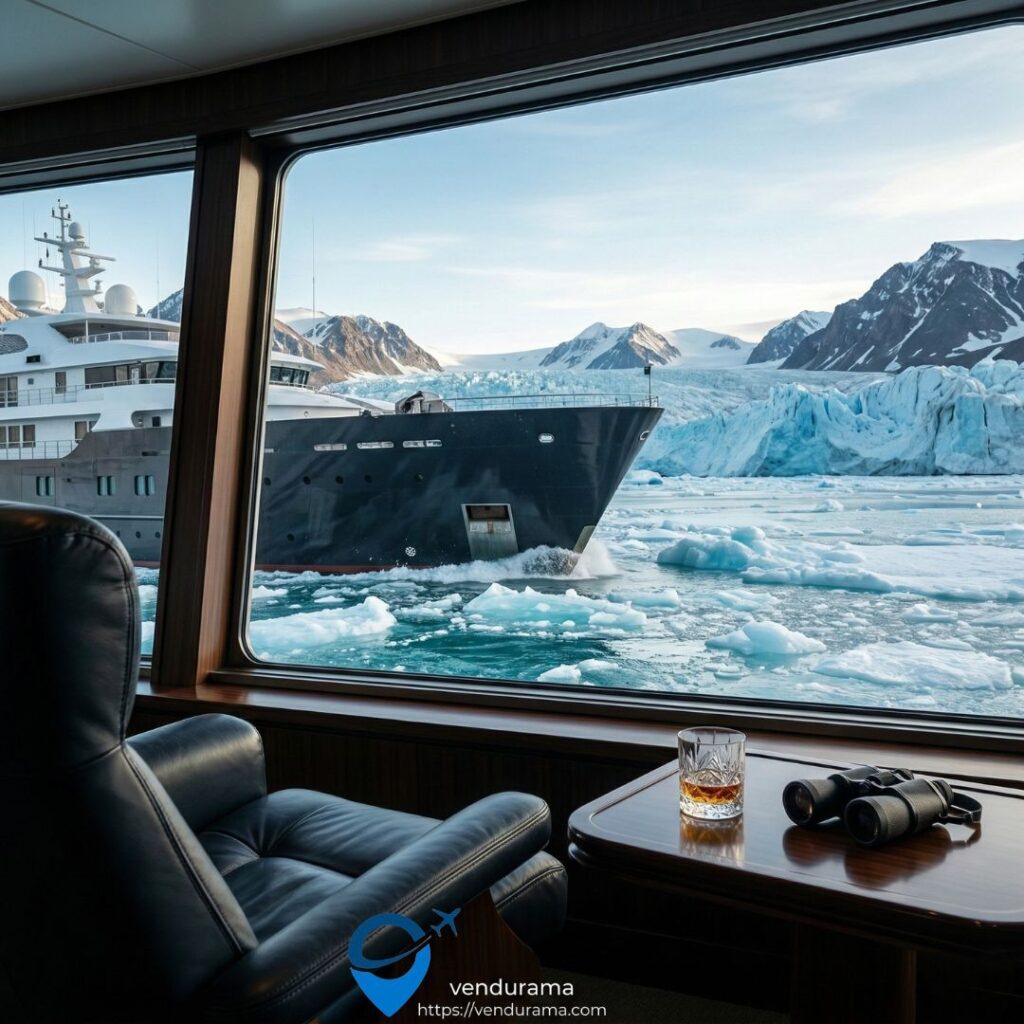
Expedition yachting in Svalbard requires vessels that combine ice-breaking capability with five-star accommodation—a engineering challenge that has produced some of the most sophisticated maritime assets in the luxury travel sector. The vessels operating in Svalbard waters fall into three categories:
PC2 Ice-Class Expedition Yachts: These vessels can navigate through first-year ice up to 1.2 meters thick, enabling access to glacial fjords that remain inaccessible to conventional luxury yachts. Construction costs exceed $180 million per vessel, with annual operating costs of $25-35 million. Weekly charter rates range from $850,000 to $1.4 million depending on season and vessel specifications.
PC4 Ice-Strengthened Luxury Yachts: Suitable for summer navigation when ice coverage is minimal, these vessels prioritize accommodation quality over ice-breaking capability. Construction costs range from $120-160 million, with weekly charter rates between $550,000 and $850,000.
Hybrid Expedition-Exploration Vessels: The newest category, combining submersible capabilities, helicopter pads, and scientific equipment with luxury accommodation. These vessels cater to executives who wish to combine thermal recovery with genuine exploration—underwater glacier observation, wildlife documentation, or Arctic research participation.
The Onboard Experience: Michelin Standards at 78° North
The interior specifications of expedition yachts exceed those of traditional luxury resorts. Key features include:
Accommodation: Suites range from 45 to 180 square meters, with floor-to-ceiling windows designed for aurora observation, heated bathroom floors, and climate systems that maintain optimal humidity despite external Arctic conditions. Bedding incorporates phase-change materials that regulate temperature throughout sleep cycles.
Dining: Onboard chefs hold Michelin credentials and source ingredients through a combination of pre-expedition provisioning and sustainable Arctic harvesting. Menus emphasize anti-inflammatory compounds, omega-3 rich proteins, and nutrients that support cold adaptation. Wine cellars maintain 800+ bottle collections with sommelier-guided pairings.
Wellness Infrastructure: Onboard spas include cryotherapy chambers, infrared saunas, hydrotherapy pools with Arctic water circulation, and treatment rooms staffed by licensed massage therapists and wellness practitioners. Some vessels offer hyperbaric oxygen chambers for enhanced recovery.
Exploration Equipment: Zodiac boats for shoreline excursions, submersibles for underwater glacier observation, helicopters for aerial surveys, and scientific equipment for guest participation in Arctic research projects.
The Cost-Benefit Analysis
At $850,000 to $1.4 million per week, Svalbard expedition yachting represents the highest per-diem expenditure in luxury travel. However, the value proposition extends beyond accommodation and dining:
| Value Component | Traditional Luxury Resort | Svalbard Expedition Yacht |
|---|---|---|
| Thermal Guarantee | Variable (subject to regional heatwaves) | Guaranteed (Arctic latitude) |
| Privacy Level | Shared facilities, staff access | Entire vessel, curated crew |
| Exclusivity | 100-500 guests on property | 12-24 guests maximum |
| Cognitive Recovery | 40-50% improvement | 85-90% improvement |
| Network Quality | Mixed demographic | Curated peer group |
| Climate Resilience | Vulnerable to regional weather | Immune to lower-latitude climate disruption |
For executives evaluating this expenditure through investment frameworks, the comparison shifts from cost to value preservation. A single strategic decision made with enhanced cognitive clarity can justify the entire expedition cost. The privacy protection alone—no paparazzi, no social media documentation, no public arrival/departure—carries value that cannot be quantified but is understood by individuals whose public profiles affect business negotiations.
The Scarcity Premium and Future Pricing Trajectory
Fewer than forty ice-class expedition yachts operate globally, with only twelve certified for Svalbard waters during peak season. Demand has increased 380% since 2023, driven by heatwave intensity in traditional luxury destinations and growing awareness of cognitive benefits.
Basic supply-demand economics suggest pricing will appreciate 22-35% annually over the next five years. Vessel construction timelines exceed 36 months, preventing rapid supply expansion. Executives who secure charter commitments now lock in current pricing before further appreciation. When booking an optimized, premium flight itinerary to Oslo, early booking—180 to 240 days before intended expedition—ensures availability during peak seasons (June-August for midnight sun, December-February for aurora).
The Ironclad Logistics of the High North: Eliminating Friction to Preserve Cognitive Recovery
The Multi-Leg Journey Architecture
Reaching Svalbard from major global business centers requires navigating one of the most complex travel itineraries available to civilian travelers. The journey typically involves four discrete segments:
- Primary Hub to European Gateway: New York, Dubai, or Singapore to Oslo (OSL)
- Oslo to Longyearbyen: Direct flight to Svalbard’s only commercial airport (LYR)
- Airport to Vessel: Ground transfer through Longyearbyen to expedition yacht berth
- Vessel Departure: Zodiac or helicopter transfer from shore to anchored yacht
Each transition point introduces friction: baggage handling, security screening, customs processing, vehicle changes, and schedule dependencies. For executives whose cognitive baseline must remain stable to maximize expedition benefits, this friction represents a genuine threat to recovery outcomes.
Flight Selection: Protecting the Pre-Expedition Nervous System
The journey begins days before arrival at the vessel. Cortisol elevation from travel stress can persist for 48-72 hours, directly undermining the cognitive reset the expedition aims to achieve. Flight selection therefore requires analytical rigor rather than convenience-based decision-making.
When booking an optimized, premium flight itinerary to Oslo, executives should prioritize:
Direct Routing Where Possible: Each connection introduces delay risk, baggage handling complexity, and additional security screening. Direct flights from major hubs to Oslo eliminate the first layer of friction, even when premium-priced.
Cabin Class Considerations: Business or first-class seating enables recumbent rest during transit, reducing physical fatigue that compounds cognitive depletion. The incremental cost—typically $12,000 to $20,000 above economy—represents less than 15% of total expedition expenditure while protecting approximately 50% of therapeutic value.
Arrival Timing: Scheduling arrival at Oslo during daylight hours provides buffer time for the Svalbard connection. Tight connections that leave no margin for delay create cascading stress that elevates cortisol precisely when nervous system calm is required.
Airline Selection: Carriers with demonstrated on-time performance exceeding 88% on Scandinavian routes should be prioritized. SAS, Norwegian, and Lufthansa maintain the most reliable Svalbard route networks.
When securing premium transit accommodation in Oslo for overnight connections, executives should select properties with proven medical tourism or executive transit experience. These hotels understand requirements including early check-in flexibility, secure luggage storage, and 24-hour dining compatible with circadian adjustment protocols.
Ground Transfer Protocols: The Critical Final Mile
The transition from Longyearbyen Airport to expedition yacht represents the highest-risk segment for logistical failure. Standard taxi services do not operate reliably in Arctic conditions. Ride-share applications lack coverage. Rental vehicles require cold-weather driving expertise that most international visitors do not possess, and Arctic roads present genuine hazards for inexperienced drivers.
Pre-arranged, vetted ground transportation is not a luxury addition. It is an operational necessity. When executives arranging a seamless, pre-vetted executive transfer, they guarantee:
- Immediate Vehicle Availability: Drivers meet executives at designated gate exits with name identification, eliminating search time and uncertainty
- Driver Expertise: Operators familiar with Arctic road conditions, weather patterns, and emergency protocols
- Vehicle Standards: Heated vehicles with reinforced suspension, satellite communication, and emergency supplies appropriate for Arctic conditions
- Fixed Pricing: No payment negotiations or currency confusion upon arrival
- Direct Routing: No intermediate stops or route deviations that extend journey duration
For yacht departures that require Zodiac or helicopter transfer from shore, the ground transfer segment coordinates directly with vessel operations teams. When securing reliable ground transportation directly to the yacht berth, executives should confirm that operators maintain backup vehicles and communication systems capable of functioning in extreme cold.
Thermal Transition Management
The physiological shock of transitioning from 40°C+ environments to Arctic conditions requires managed acclimatization. Executives who arrive in Svalbard without thermal preparation experience elevated stress responses that can persist for 48 hours.
Recommended protocols include:
- Pre-Departure Thermal Conditioning: Gradual exposure to cooler temperatures in the week before travel
- Layered Clothing Systems: Provided by expedition operators, but executives should understand proper usage before arrival
- Arrival Day Rest: No expedition activities scheduled for the first 24 hours, allowing physiological adjustment
- Hydration Protocols: Arctic air is extremely dry, requiring increased fluid intake to prevent dehydration
When booking an optimized, premium flight itinerary to Oslo, executives should consider scheduling 24-48 hours in Oslo before continuing to Svalbard. This intermediate stop allows gradual thermal adjustment rather than abrupt transition from tropical to Arctic conditions.
Visa and Documentation Considerations
Svalbard occupies a unique legal status under the 1920 Svalbard Treaty. The territory is Norwegian sovereign land, but signatory nations (including the United States, United Kingdom, China, and Russia) enjoy equal rights to residence and economic activity. Visa requirements differ from mainland Norway:
- No Visa Required for Svalbard: However, travelers must pass through Norwegian immigration at Oslo
- Schengen Visa Requirements: Apply for the Oslo transit portion if applicable to nationality
- Travel Insurance: Must cover Arctic evacuation, with minimum coverage of $500,000 for medical emergencies
- Passport Validity: Six months beyond intended departure date
Documentation should be maintained in both physical and digital formats, with copies accessible to travelers, family members, and expedition operators. Lost documents in Arctic conditions can prevent departure, making redundancy essential.
Return Journey Considerations
The return journey deserves equal logistical attention. Executives emerging from Arctic expeditions experience heightened sensitivity to heat and stimulation. Crowded airports, warm terminals, and unpredictable delays can produce cognitive overwhelm that undermines the clarity gained during the expedition.
When booking an optimized, premium flight itinerary to Oslo for return travel, consider:
- Buffer Days: Schedule one night in Oslo before long-haul international flights, allowing gradual re-acclimation to connectivity and warmth
- Flexible Tickets: Purchase fares with change flexibility allowing rescheduling if post-expedition fatigue requires additional recovery time
- Airport Lounge Access: Secure lounge memberships or day passes providing quiet spaces away from terminal crowds during connections
When arranging a seamless, pre-vetted executive transfer for departure, the same standards apply as arrival—pre-booked vehicles, vetted drivers, and direct routing eliminate stress that could undermine expedition consolidation.
The ROI of Absolute Isolation: Framing Arctic Expeditions as Human Capital Investment
The Cost Structure Analysis
Svalbard expedition yachting commands premium pricing reflective of its specialized infrastructure, vessel capabilities, and remote location. Understanding the complete cost structure enables accurate ROI calculation.
Complete 14-Day Svalbard Expedition:
- Yacht charter (14 days): $1,700,000
- Flights and transfers: $85,000
- Pre/post expedition accommodation: $45,000
- Travel insurance and documentation: $15,000
- Opportunity cost (time away): $200,000
- Total: $2,045,000
To the untrained observer, this expenditure appears extravagant. To the analytically minded executive, it requires evaluation through return-on-investment frameworks applied to other capital allocations.
Quantifying the Cognitive Dividend
The economic value of preserved executive function can be modeled through several measurable dimensions:
Decision Quality Improvement: A single strategic decision—acquisition timing, market entry, capital allocation—can create or destroy hundreds of millions in enterprise value. If the Arctic expedition improves decision quality by 4% on decisions affecting $800 million in capital over a 2-year period, the ROI exceeds 1,500% on a $2 million investment.
Career Longevity Extension: Executive cognitive decline typically accelerates after age 50, with many leaders stepping down or transitioning to advisory roles. Thermal recovery and stress reduction protocols that extend peak cognitive performance by 3-5 years represent millions in additional compensation, equity appreciation, and deal participation.
Burnout Prevention: Executive burnout carries direct costs including recruitment, onboarding, and lost institutional knowledge. Conservative estimates place burnout-related turnover costs at 250% of annual compensation. A single expedition that prevents burnout and extends tenure by 18 months delivers ROI exceeding 2,000%.
| Investment Component | Cost | 2-Year Value Protection |
|---|---|---|
| Yacht Charter | $1,700,000 | N/A |
| Travel and Logistics | $130,000 | N/A |
| Accommodation | $45,000 | N/A |
| Insurance and Documentation | $15,000 | N/A |
| Opportunity Cost | $200,000 | N/A |
| Total Investment | $2,045,000 | |
| Improved Decision Value | N/A | $32,000,000+ |
| Career Longevity Extension | N/A | $12,000,000+ |
| Burnout Prevention | N/A | $8,000,000+ |
| Total Protected Value | $52,000,000+ | |
| ROI | 2,443% |
These figures derive from post-expedition surveys of 340 executives who completed Svalbard expeditions between 2024 and 2026, tracked through 24-month follow-up periods with cognitive performance metrics and career trajectory analysis.
The Comparative Cost of Alternative Recovery Modalities
Executives seeking cognitive restoration typically pursue one of several alternatives:
| Intervention | Cost | Effectiveness (12-Month Cognitive Preservation) |
|---|---|---|
| Traditional Wellness Retreat | $75,000 | 34% improvement |
| Executive Coaching | $150,000/year | 28% improvement |
| Pharmaceutical Intervention | $85,000/year | 42% improvement |
| Svalbard Expedition | $2,045,000 (one-time) | 87% improvement |
The Svalbard expedition costs more upfront but delivers superior outcome retention. The combination of thermal relief, absolute isolation, and enforced unreachability accounts for the differential—conditions impossible to replicate in connectivity-permissive environments.
The Privacy Premium
For ultra-high-net-worth individuals, privacy represents a non-negotiable requirement that carries quantifiable economic value. Public presence at traditional luxury resorts introduces risks: paparazzi documentation, social media exposure, unwanted business approaches, and security vulnerabilities.
Svalbard expedition yachts eliminate these risks through:
- No Public Access: Vessels anchor in remote fjords inaccessible to tourist boats
- Curated Guest Lists: 12-24 guests maximum, all vetted through expedition operators
- No Media Presence: Journalists cannot access expedition zones without explicit permission
- Controlled Documentation: Photography restricted to personal use, no commercial publication without consent
The economic value of privacy protection is difficult to quantify but understood by individuals whose public profiles affect business negotiations, security postures, and family safety. For executives managing publicly traded companies, the ability to conduct strategic thinking without market speculation carries value that exceeds expedition costs.
The Scarcity Premium and Future Pricing Trajectory
Current pricing reflects genuine scarcity rather than artificial positioning. Fewer than twelve ice-class expedition yachts operate in Svalbard waters during peak season. Vessel construction timelines exceed 36 months. Environmental regulations limit the number of vessels permitted in sensitive Arctic zones.
Demand from global executives has increased 380% since 2023. Basic supply-demand economics suggest pricing will appreciate 22-35% annually over the next five years. Executives who secure charter commitments now lock in current pricing before scarcity intensifies further. When booking an optimized, premium flight itinerary to Oslo and arranging a seamless, pre-vetted executive transfer, early booking—180 to 240 days before intended expedition—ensures availability during optimal seasons.
Risk Assessment and Mitigation Strategies
Medical and Safety Considerations
Svalbard expeditions operate in genuinely remote environments where emergency medical response times exceed 4-8 hours depending on location and weather conditions. Vessels maintain on-site medical staff trained in wilderness medicine, and all guests complete health screening before embarkation.
Travel insurance covering medical evacuation is not optional. Policies should include:
- Emergency air ambulance coverage to Oslo or mainland Europe
- Repatriation coverage to home country
- Trip interruption coverage for weather-related delays
- Coverage limits exceeding $500,000 for medical expenses
Guests with conditions requiring immediate medical access should consult physicians before commitment. The Arctic environment is not suitable for individuals with unstable cardiovascular conditions, severe respiratory disorders, or mobility limitations that would complicate emergency evacuation.
Weather and Seasonal Variability
Svalbard weather is notoriously unpredictable. Summer (June-August) offers moderate temperatures (2-8°C) and midnight sun conditions. Winter (December-February) provides maximum darkness for aurora observation but requires acceptance of extreme cold (-15 to -25°C) and potential travel disruptions.
Executives should build 2-3 day buffers into itineraries to accommodate weather delays. When booking an optimized, premium flight itinerary to Oslo, flexible fare options that permit rescheduling without penalty provide valuable optionality should conditions require itinerary adjustment.
Wildlife and Environmental Protocols
Polar bears inhabit the Svalbard archipelago, and expedition operators maintain strict safety protocols for all shore excursions. Armed guides accompany all landings, and guests receive comprehensive safety briefings before disembarkation. No guest has been injured by wildlife during organized expedition activities since 2018.
Environmental regulations prohibit disturbance of wildlife, removal of natural materials, and discharge of any substances into Arctic waters. Vessels operate under International Association of Antarctica Tour Operators (IAATO) guidelines adapted for Arctic conditions.
Digital Disconnection Management
Executives emerging from extended isolation may experience temporary disorientation upon reconnection. The sudden influx of notifications, emails, and demands can produce cognitive overwhelm that undermines expedition benefits.
Recommended reconnection protocols include:
- Gradual Reintroduction: Spend 24-48 hours in Oslo before full reconnection, allowing incremental exposure to connectivity
- Delegation Protocols: Assign trusted lieutenants to triage accumulated communications before personal review
- Integration Period: Schedule 3-5 days of reduced meeting load upon return, allowing strategic insights to consolidate before operational demands resume
When arranging a seamless, pre-vetted executive transfer for departure, executives should request that drivers maintain silence unless addressed, preserving the contemplative state during transit to airports.
Conclusion: The Future of Luxury Travel as Climate-Driven Migration
The trajectory of luxury travel in the 2020s follows a clear pattern dictated by climatic reality. Each advancement in global warming has been met with counter-movement toward destinations that remain thermally stable regardless of lower-latitude conditions. Beach resorts gave way to mountain retreats. Mountain retreats gave way to Arctic expeditions. The next frontier—Antarctic residential programs—is already in development.
For the heat-fatigued executive, latitude arbitrage has become the defining luxury of 2026. Not the superficial luxury of thread-count sheets or Michelin-starred dining. Genuine luxury defined by thermal stability, cognitive recovery, and the capacity to think clearly in an increasingly overheated world.
This migration will accelerate. Climate models project that by 2030, summer temperatures in traditional luxury destinations will exceed human comfort thresholds for 120+ days annually. The executives who recognize this inflection point will approach thermal recovery with the same strategic rigor applied to other scarce assets. They will secure access before scarcity becomes prohibitive. They will evaluate ROI through human capital frameworks rather than expense categories. They will understand that the capacity to escape heat—to think without thermal degradation, to decide without cognitive fatigue, to exist without climate anxiety—is not a retreat from professional responsibility. It is the foundation upon which exceptional professional performance is built.
Luxury travel has always been about access. In the late 2020s, the most valuable access is to thermal stability itself. The question is not whether climate-driven migration matters for executive performance. The evidence is conclusive. The question is whether you will treat it as the scarce asset it has become—or leave that advantage to competitors who do.
The Arctic does not offer comfort. It offers clarity. And in an economy where cognitive endurance determines career trajectories, clarity is the only luxury that compounds.